
Kelda
Kelda connects your labs, medications, symptoms, and wearables to uncover hidden health patterns doctors often miss.
Visit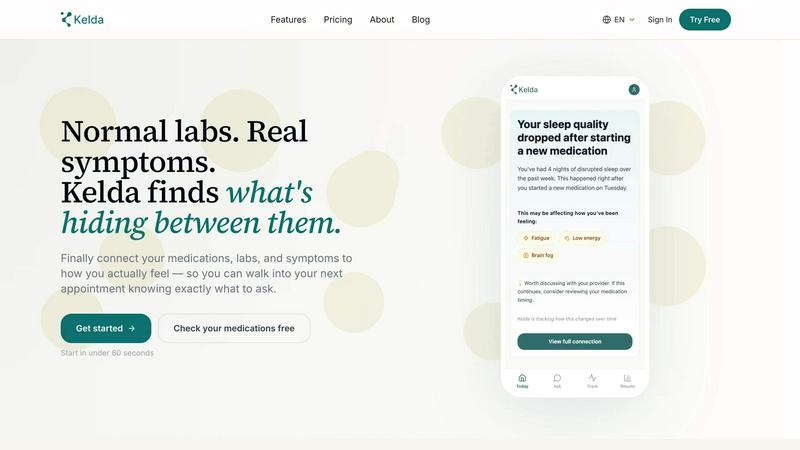
About Kelda
Kelda is a health and wellness platform designed to help people understand the complex connections between medications, nutrients, biomarkers, symptoms, and overall wellbeing. It addresses a critical gap in modern healthcare where patients often receive lab results marked "within range" yet continue to experience persistent symptoms like fatigue, brain fog, mood shifts, and sleep disturbances. Kelda cross-references your medications, lab results, symptoms, and wearable data in one unified place to find patterns that are easy to miss in fragmented care. The platform is built for anyone who has seen multiple doctors, completed numerous tests, and still feels stuck without answers. It is especially valuable for individuals managing chronic conditions such as PCOS, hypothyroidism, iron deficiency, endometriosis, perimenopause, fibromyalgia, Hashimoto's, chronic fatigue, autoimmune conditions, and many others. Kelda simplifies complex health information by publishing clear, research-informed content on medication depletion patterns, lab markers, nutrient interactions, supplement timing, and common health questions. The goal is to help users move from confusion to clarity, enabling them to make better-informed decisions and have more productive conversations with their healthcare providers. By combining educational resources, structured health content, and practical insights, Kelda empowers users to explore how prescriptions, vitamin status, and lab results may relate to energy, mood, metabolism, and long-term health patterns. The platform was inspired by a personal story where a family member spent years searching for answers across top specialists, only to have Kelda surface one pattern that linked everything together. Now, Kelda helps everyone find the same kind of clarity.
Features of Kelda
Medication to Nutrient Depletion Analysis
Kelda automatically cross-references your medications against known nutrient depletion patterns. For example, it can identify that omeprazole may be depleting magnesium, which is commonly linked to fatigue, cramps, and poor sleep. This feature helps users understand why they might be experiencing specific symptoms that their doctors never connected to their prescriptions. By surfacing these hidden relationships, Kelda enables users to address root causes rather than just treating symptoms.
Lab Result Optimization Insights
Kelda goes beyond standard lab ranges to provide optimization insights. When your ferritin level is 25, your doctor may say it is normal, but Kelda identifies that optimal levels for preventing hair loss and maintaining energy start at 70. This feature helps users understand the difference between being "within range" and being truly optimal, empowering them to pursue better health outcomes rather than settling for mediocre lab results.
Symptom and Wearable Data Pattern Detection
Kelda brings together your symptoms and wearable data to detect patterns over time. If your sleep quality dropped after starting a new medication, and your energy and mood shifted at the same time, Kelda will surface this correlation. This feature helps users identify temporal relationships between their lifestyle changes, medication adjustments, and how they feel, providing a clearer picture of their health trajectory.
Comprehensive Condition Cross-Referencing
Kelda supports a wide range of health conditions, from common ones like anxiety and depression to complex issues like mast cell activation, histamine intolerance, drug-induced nutrient depletion, thyroid conversion failure, and HPA axis dysregulation. The platform cross-references your unique data against these conditions to find connections that are easy to miss. This feature is particularly valuable for individuals with multiple diagnoses who need to understand how their conditions interact with each other and with their medications.
Use Cases of Kelda
Persistent Unexplained Symptoms
A user has seen multiple specialists and received normal lab results, but continues to experience fatigue, brain fog, and poor sleep. Kelda cross-references their medications, labs, and symptoms to identify hidden patterns, such as a medication depleting essential nutrients or a lab value that is technically normal but suboptimal for their specific symptoms. The user can then bring these findings to their doctor for a more informed discussion.
Managing Chronic Conditions
An individual with PCOS, hypothyroidism, and iron deficiency is struggling to manage all three conditions simultaneously. Kelda helps them understand how these conditions interact, how their medications might be affecting their nutrient levels, and what lab markers they should monitor more closely. The platform provides a unified view of their health data, making it easier to track progress and adjust their approach over time.
Post-Medication Adjustment Monitoring
A user has recently started a new medication for anxiety and wants to understand how it might affect their energy, mood, and sleep. Kelda monitors their wearable data and symptom logs to detect any shifts that coincide with the medication change. The platform can identify patterns like sleep disruption or mood changes and link them to potential nutrient depletions caused by the medication, helping the user decide whether to discuss alternatives with their doctor.
Preparing for Healthcare Appointments
A user has an upcoming appointment with their primary care physician and wants to make the most of the limited time. Kelda generates a comprehensive summary of their health data, including identified patterns, potential nutrient depletions, and specific questions to ask. This preparation helps the user walk into the appointment more informed and confident, leading to more productive conversations and better care.
Frequently Asked Questions
How does Kelda find connections between my medications and symptoms?
Kelda uses a combination of research-informed algorithms and your personal health data to identify patterns. When you upload your medications, lab results, symptoms, and wearable data, the platform cross-references everything against known medical literature on drug-nutrient interactions, optimal lab ranges, and symptom correlations. For example, if you are taking omeprazole and experiencing fatigue, Kelda will check if that medication is known to deplete magnesium, which is linked to fatigue. The platform then presents these potential connections in a clear, actionable format.
Is my health data secure on Kelda?
Kelda takes data privacy and security seriously. Your health information is encrypted and stored securely. The platform is designed to be a personal health companion, meaning your data is used only to generate insights for you. Kelda does not share your personal health information with third parties without your explicit consent. You maintain full control over your data and can delete it at any time.
Can Kelda replace my doctor or healthcare provider?
No, Kelda is not a replacement for medical professionals. It is a health companion that helps you understand your data and prepare for more informed conversations with your healthcare providers. The insights generated by Kelda are research-informed but should be reviewed with your doctor before making any changes to your medications, supplements, or treatment plans. Kelda empowers you to ask better questions and advocate for your health, but it does not provide medical diagnoses or treatment recommendations.
What types of health conditions does Kelda support?
Kelda supports a wide range of conditions including PCOS, hypothyroidism, iron deficiency, B12 deficiency, endometriosis, perimenopause, fibromyalgia, insulin resistance, IBS, Hashimoto's, chronic fatigue, anxiety and depression, migraine, autoimmune conditions, hormonal imbalance, PMDD, gut inflammation, SIBO, and many more. The platform also covers complex issues like drug-induced nutrient depletion, thyroid conversion failure, CYP enzyme inhibition, HPA axis dysregulation, methylation deficiency, and copper-zinc imbalance. If you have a condition that is not listed, you can still use Kelda to track your medications, labs, and symptoms.
Similar to Kelda

Translate JSON, Markdown, and TXT files while preserving keys, nested paths, and project structure.

SnitchFeed is an agentic social listening tool that surfaces high-intent conversations on LinkedIn, X, Hackernews, and more for GTM and product teams.


Where modern software products get discovered, launched, and distributed. Explore verified AI tools, SaaS startups, and developer software.

Z Image Turbo is an online AI image generator for photorealistic images, bilingual posters, ecommerce visuals, ads, and social content.

Enhance photos, create images, and generate videos with AI workflows, effects, and production-tested models.

Run affiliate, UGC and influencer campaigns from one place

AI regulatory intelligence platform that turns complex requirements into cited, audit-ready outputs.