
Tin Computer
Tin Computer agentically optimizes your product by learning from user data, shipping experiments, and fixing bugs on autopilot to continuously.
Visit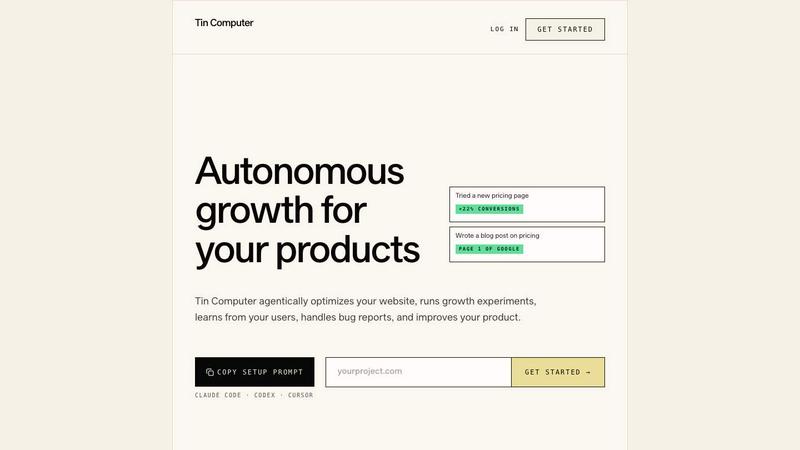
About Tin Computer
Tin Computer is an autonomous AI growth agent designed specifically for small SaaS teams who want to ship continuous improvements without dedicating their entire roadmap to growth experiments. It connects directly to your existing stack, including GitHub, Stripe, Google Analytics, Search Console, PostHog, Sentry, and Vercel, and begins working immediately on the surfaces you already own. Instead of requiring a brief, a backlog, or a growth team, Tin Computer reads your project, identifies what is slowing growth down, builds and ships the fix or experiment, and then watches the result to learn what worked. It operates in a continuous cycle of noticing, shipping, and learning, which means your product is always being optimized. The core philosophy is organic growth with no ad spend and no cold outreach. Tin Computer handles organic SEO through blog posts, comparison pages, and technical fixes. It improves product engineering by shipping bug fixes, small features, and onboarding tweaks. It also manages analytics by running funnel diagnostics, cohort analysis, and experiment tracking. Every change is delivered as a real pull request that you review and merge, giving you full control over what ships. The product is ideal for founders, indie developers, and small teams who want to maintain and grow multiple projects without hiring a full growth team. A powerful case study shows Claw Messenger, a dormant side project, grew from $480 to $13,500 ARR and from 4 to 146 paying customers in just 112 days after connecting Tin Computer. This is not a tool for planning growth. It is a tool that executes growth on autopilot, 24 hours a day, 7 days a week, so you can focus on building while it handles the iterative optimization loop.
Features of Tin Computer
Autonomous Growth Cycle
Tin Computer operates on a continuous three-step loop that never stops. First, it notices what is happening in your funnel by reading analytics data, user behavior, and support emails. Second, it ships the fix or experiment by writing code, creating content, or adjusting pricing, all through pull requests. Third, it learns from the outcome by measuring results and keeping what worked while discarding what did not. This cycle repeats indefinitely, meaning your product is always improving without you needing to write a single new task.
Multi-Specialist Agent Architecture
Behind the single interface of Tin Computer sits a team of specialized AI agents, each owning a specific growth lane. There is a strategist, a research analyst, an organic growth engineer, a paid acquisition engineer, a sales outreach specialist, a product analyst, a financial analyst, a product engineer, and a customer support engineer. This structure ensures that every aspect of your product, from SEO to pricing to user onboarding, gets expert-level attention. You talk to one agent, but the work is distributed across a full team of specialists.
Deep Stack Integration
Tin Computer plugs directly into the tools you already use without requiring any new setup or migration. It connects to GitHub for code changes and pull requests, Stripe for billing and pricing experiments, Google Analytics and Search Console for traffic and SEO analysis, PostHog for product analytics, Sentry for error tracking, Vercel for deployment, and your support email for customer feedback. This deep integration allows Tin Computer to read your entire product ecosystem and make informed decisions based on real data.
Full Stack Experimentation
Tin Computer does not limit itself to one type of growth experiment. It can ship a pricing change one week, a comparison page the next, and a tighter signup flow the week after. It handles organic SEO improvements like blog posts and technical fixes, product engineering changes like bug fixes and onboarding tweaks, and analytics-driven experiments like funnel diagnostics and cohort analysis. Every experiment is built from start to finish and delivered as a real pull request that you review and merge.
Use Cases of Tin Computer
Reviving Dormant Side Projects
Many founders have side projects that have flatlined with minimal revenue and few users. Tin Computer can revive these projects by continuously running growth experiments without requiring any founder time. The Claw Messenger case study demonstrates this perfectly. A project generating only $480 ARR with four paying customers was connected to Tin Computer. Over 112 days, the agent shipped over 160 commits, launched a referral program the same day a user asked for one, and added a reseller tier the day after another customer requested it. The result was $13,500 ARR and 146 paying customers. The project went from dormant to thriving entirely through autonomous growth.
Continuous SEO and Content Optimization
For SaaS teams that rely on organic traffic, maintaining a steady stream of SEO-optimized content is critical but time-consuming. Tin Computer handles this by writing blog posts, creating comparison pages, and fixing technical SEO issues automatically. It watches search console data to identify which keywords are underperforming and ships new content to capture that traffic. It also updates existing pages to improve rankings. This means your organic search presence is always growing, even when you are not actively working on content.
Automated Product Improvement and Bug Fixing
Small teams often struggle to balance feature development with bug fixing and onboarding improvements. Tin Computer fills this gap by continuously monitoring your codebase through GitHub and your error tracking through Sentry. When it identifies a bug that is causing user churn or a friction point in the onboarding flow, it writes the fix and opens a pull request. It also ships small features that improve user experience, such as tighter signup flows or better trial experiences. This keeps your product polished and user-friendly without distracting your engineering team.
Building a Portfolio of Growing Products
Founders and indie developers often have multiple ideas and projects they want to maintain, but time constraints force them to focus on only one. Tin Computer allows you to build a portfolio of products that all grow autonomously. You simply connect each project to the agent, and it runs growth experiments on each one independently. You no longer have to choose which project to prioritize because Tin Computer works on all of them simultaneously. This turns your waiting list of projects into a portfolio of growing assets.
Frequently Asked Questions
How does Tin Computer decide what to work on next?
Tin Computer reads your entire product ecosystem through its integrations with GitHub, Stripe, Google Analytics, Search Console, PostHog, Sentry, and your support email. It analyzes your funnel to find where growth is slowing down. It looks at user behavior, error logs, support requests, and revenue data to identify the highest-impact experiment or fix. It then prioritizes that work and ships it. After the result is measured, it moves to the next bottleneck. This prioritization is data-driven and continuous.
Do I have control over what Tin Computer ships?
Yes, full control. Tin Computer ships every change as a real pull request to your GitHub repository. You review the code, see the expected impact, and decide whether to merge it. Nothing goes live without your approval. This means you maintain complete ownership of your product and codebase while still getting the benefit of autonomous growth recommendations and implementations. You can also adjust the agent's focus or pause it at any time.
What types of projects does Tin Computer work with?
Tin Computer works best for web-based SaaS products, marketing sites and blogs, indie developer tools, marketplaces and directories, and projects built with Lovable, Bolt, or Replit. It requires your project to live on the open web with code you control through GitHub. It does not currently work with mobile apps, native desktop applications, drag-and-drop no-code platforms like Bubble or Webflow, or e-commerce stores on Shopify or Etsy. The product is designed for teams that write and manage their own code.
How fast can I expect to see results?
Results depend on your current product state and how much work the agent can identify. In the Claw Messenger case study, the project grew from $480 to $13,500 ARR and from 4 to 146 paying customers in 112 days, which is about 16 weeks. The agent shipped over 160 commits during that period. Tin Computer offers different pricing tiers that determine how many tasks it ships per week. The Standard plan ships 30 tasks per week, while the Unlimited Growth plan ships an unlimited number of tasks. You can scale up or down at any time.
Pricing of Tin Computer
Tin Computer offers two pricing tiers. The Standard plan is $99 per month and includes 30 tasks per week. The Unlimited Growth plan is $299 per month and includes unlimited tasks per week. Both plans include the full set of features, including all specialist agents, deep stack integrations, and full stack experimentation. You can cancel at any time and move up or down between plans whenever you want. There are no long-term contracts or hidden fees.
Similar to Tin Computer

CleanSmart removes duplicates, fixes formatting, fills gaps, and flags anomalies in one automated pass. No code. No data engineers.

Peak Answer helps brands understand when AI search engines recommend them, where competitors win, and most importantly, how to close the gap.

Search 20,000+ open-source and SaaS tools by the job you need done or the app you want to replace.

Your Social Media Content Engine That Drives Revenue. Distribute your content to every social media platform and track it in real time.

The #1 Native Form Builder Plugin for Framer - No Code, No Embeds, No External Platforms.

Create AI UGC video ads from a product URL, image, or script with lifelike creators, natural voices, captions, product visuals, and clear CTAs.

Z Image Turbo is an online AI image generator for photorealistic images, bilingual posters, ecommerce visuals, ads, and social content.

AI SEO platform for keyword research, content briefs, writing, grading, optimization and publishing.