
Self-Healing Integrations
Plumbed.io continuously heals and evolves your enterprise integrations, replacing costly custom projects with an AI-managed lifecycle that keeps them.
Visit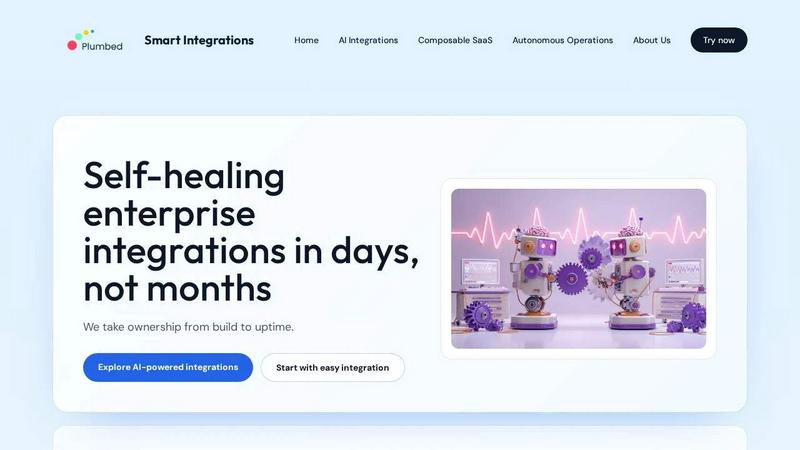
About Self-Healing Integrations
Self-Healing Integrations by Plumbed.io represent a fundamental shift in how enterprises approach system connectivity. Unlike traditional integration tools that simply build a connection and leave it to degrade, this product introduces an AI-managed lifecycle that continuously monitors, maintains, and optimizes integrations long after they go live. The core philosophy is that integration is not a one-time project but an ongoing operational commitment. For companies burdened by the integration tax, where every new channel, system, or partner launch becomes slow and expensive, Plumbed.io offers a prompt-driven, production-ready platform that takes full ownership from build to uptime. This product is purpose-built for custom enterprise integrations that require constant adaptation, proactive error handling, and automated updates. By replacing fragile point-to-point connections with a self-healing architecture, it eliminates the operational overhead that typically balloons as businesses scale. The AI engine works iteratively, learning from each interaction to improve reliability and reduce the need for human intervention. Whether you are connecting a legacy ERP to a modern CRM or onboarding a new logistics partner, Self-Healing Integrations ensure your data flows consistently, your systems stay synchronized, and your engineering teams are freed from the endless cycle of break-fix maintenance. The result is faster deployment, lower total cost of ownership, and a resilient integration ecosystem that evolves with your business.
Features of Self-Healing Integrations
AI-Managed Lifecycle Automation
The platform replaces manual integration maintenance with a continuous, AI-driven lifecycle that covers monitoring, error detection, and proactive healing. Instead of waiting for a connection to break and then dispatching a developer to fix it, the system automatically identifies anomalies, diagnoses root causes, and applies corrective actions in real time. This cyclical process of observe, analyze, and repair ensures that integrations remain stable without human oversight. Over time, the AI learns from historical patterns to predict potential failures before they occur, further reducing downtime. This feature is essential for enterprises that cannot afford interruptions in critical data flows between systems like ERPs, CRMs, and e-commerce platforms.
Prompt-Driven Integration Builder
Building new integrations is simplified through a prompt-driven interface that allows users to define connection logic using natural language or structured commands. This eliminates the need for extensive coding or deep technical expertise, enabling business analysts and operations teams to participate in the integration process. The system interprets these prompts, generates the necessary configuration, and deploys the integration into production quickly. As requirements change, users can iteratively refine their prompts, and the platform adapts the integration accordingly. This approach drastically reduces the time from concept to go-live, turning what once took months into a matter of days.
Self-Healing Error Recovery
When an integration encounters an error, the platform does not simply log it and alert a human. Instead, it employs a sophisticated self-healing engine that attempts to resolve the issue autonomously. This includes retrying failed transactions with exponential backoff, rerouting data through alternative pathways, or adjusting transformation logic to accommodate schema changes at the source or target system. If the issue is beyond automated resolution, the system provides detailed diagnostics and suggested fixes to the operations team. This continuous improvement loop means that over time, the integration becomes more resilient, as the AI expands its library of known failure patterns and healing strategies.
Continuous Schema and API Adaptation
Systems evolve, and their APIs or data schemas frequently change. Self-Healing Integrations automatically detect these changes and adapt the integration configuration without manual intervention. For example, if a CRM vendor adds a new field to a standard object or deprecates an old endpoint, the platform identifies the discrepancy, updates the mapping, and validates the new flow. This feature prevents the common scenario where a minor vendor update causes a cascading failure across connected systems. By continuously synchronizing with the latest versions of integrated applications, Plumbed.io ensures that integrations remain production-ready and do not require constant rework from engineering teams.
Use Cases of Self-Healing Integrations
Enterprise ERP to CRM Synchronization
Large enterprises often struggle to keep their ERP and CRM systems in sync, especially when dealing with complex data like customer orders, inventory levels, and shipping statuses. With Self-Healing Integrations, this synchronization becomes a managed lifecycle. The platform continuously monitors the data flow between systems like SAP or NetSuite and Salesforce or HubSpot. When a field mapping breaks due to a schema update or a data type mismatch, the AI automatically adjusts the transformation logic. This ensures that sales teams always have accurate inventory data and finance teams see real-time order status, all without manual intervention from the IT department.
Multi-Channel E-commerce Order Management
Retailers connecting their order management system to multiple sales channels, such as Shopify, Amazon, and WooCommerce, face constant challenges with order routing, inventory updates, and payment reconciliation. Self-Healing Integrations handle the complexity by automatically detecting and resolving common issues like duplicate orders, failed payment confirmations, or inventory discrepancies. The platform learns the specific quirks of each channel and iteratively improves its error handling. If an Amazon API rate limit is hit, the system automatically throttles requests and retries. This allows the retailer to scale to new channels quickly without exponential growth in operational support costs.
Healthcare Data Exchange Between EHR and Billing Systems
In healthcare, the integration between Electronic Health Records (EHR) and billing systems is critical for revenue cycle management. A failed integration can delay claims, leading to lost revenue. Self-Healing Integrations provide a reliable bridge that ensures patient encounter data, diagnosis codes, and procedure details flow accurately. The platform proactively monitors for changes in HL7 or FHIR standards and adapts the integration accordingly. If a billing system rejects a claim due to a coding error, the AI attempts to correct the issue based on historical patterns or routes the exception to a billing specialist with a detailed analysis. This reduces claim denial rates and accelerates reimbursement cycles.
Logistics and Supply Chain Partner Onboarding
When a company needs to onboard a new logistics partner, the integration work traditionally involves weeks of custom development and testing. With Self-Healing Integrations, the process is streamlined. The platform uses its prompt-driven builder to quickly define the data exchange requirements, such as shipment manifests, tracking updates, and proof of delivery. After go-live, the system continuously monitors the partner's APIs for changes. If the partner updates their data format or endpoint structure, the integration self-heals without requiring a new development cycle. This allows supply chain teams to rapidly expand their network of carriers and 3PL providers while maintaining high data quality and operational continuity.
Frequently Asked Questions
How does the self-healing capability actually work?
The self-healing capability is powered by an AI engine that continuously monitors integration health metrics, including data throughput, error rates, and response times. When an anomaly is detected, the system first attempts to classify the issue by comparing it to a library of known failure patterns. If a match is found, it executes a predefined healing strategy, such as retrying a failed API call with a different authentication method or adjusting a data transformation. If the pattern is new, the AI logs the incident and attempts to derive a resolution through iterative testing. Over time, the system learns from each incident, expanding its healing capabilities and reducing the need for human intervention.
Do I need technical skills to use the prompt-driven builder?
No, the prompt-driven builder is designed to be accessible to users with varying levels of technical expertise. You can describe the integration you need in natural language, specifying the source and target systems, the data fields to map, and any business rules. The AI interprets this prompt and generates the necessary integration configuration. For more complex scenarios, technical users can provide more structured commands, but the platform is built to lower the barrier to entry for business analysts and operations teams. This democratization of integration building is a core part of Plumbed.io's value proposition.
What happens when an integrated system updates its API?
When a connected system updates its API or data schema, Self-Healing Integrations automatically detects the change during routine health checks. The platform compares the new API specification or schema against the current integration configuration. If a discrepancy is found, such as a deprecated field or a new required parameter, the AI attempts to adapt the integration automatically. It may update field mappings, adjust data transformations, or modify authentication flows. If the change is too complex for automated adaptation, the system flags it for human review with a detailed impact analysis, ensuring that the integration remains operational with minimal disruption.
How does Plumbed.io reduce integration costs compared to traditional methods?
Traditional integration projects involve significant upfront costs for custom development, followed by ongoing expenses for maintenance, monitoring, and break-fix support. Plumbed.io replaces this model with an AI-managed lifecycle that automates the majority of these tasks. The prompt-driven builder reduces initial development time from months to days, slashing project costs. The self-healing and continuous adaptation features eliminate the need for dedicated integration maintenance teams, as the platform handles schema changes and error recovery autonomously. This cyclical improvement model means that the cost of operating integrations decreases over time, rather than increasing as the number of connections grows.
Explore more in this category:
Similar to Self-Healing Integrations


Free Chrome extension. Paste your rough point and Chrome's built-in AI writes a fresh reply for that post on X, LinkedIn, Facebook or Instagram.

Signage and kiosk infrastructure for AI agents. Your agent publishes images, video, streams, web pages and apps to screens via one plugin.screenRIG is

Genjutsu AI turns your ideas into cinematic videos, product ads, social shorts, and high-quality images in minutes.

Novastart brings apps and files onto an infinite canvas where people and AI agents can work together.

Moderation, routing, intent and scoring for any text over one Jev-compatible API, hosted in the EU.

