
hiFred
hiFred refines your product management workflow from discovery to alignment, letting you iterate and improve continuously with one click.
Visit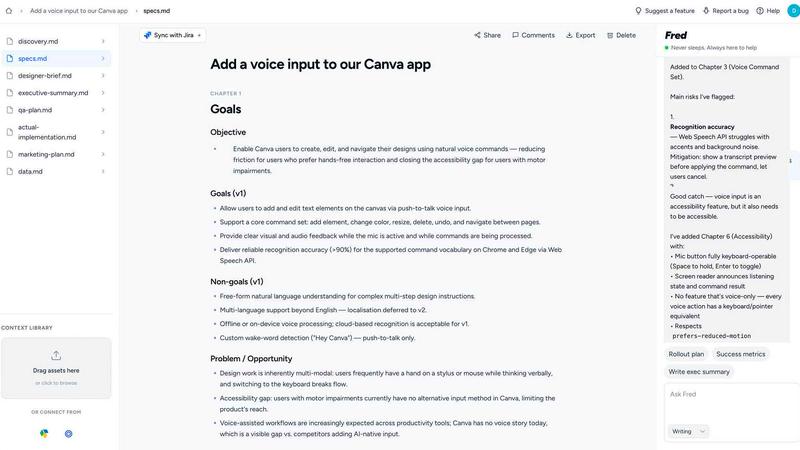
About hiFred
hiFred is an AI copilot meticulously built by product people, exclusively for Product Managers. It is designed to weave seamlessly into every stage of the PM workflow, from initial discovery and strategic spec writing to engineering handoff and cross-functional team alignment. The core value proposition is simple yet transformative: hiFred allows PMs to spend significantly less time on the coordination overhead that often bogs down product development and more time on high-impact strategy. The product introduces a paradigm shift with Live Specs, which are PRDs that evolve dynamically with every decision and conversation, never going stale. This ensures that engineering teams receive frictionless handoffs, cross-functional teams stay in sync automatically, and nothing ever slips through the cracks. hiFred connects directly to your existing stack, including Jira, Linear, Notion, Figma, Slack, and GitHub, requiring zero migration. It is also model-agnostic, allowing you to use any LLM or bring your own tokens. The product embodies a cyclical and iterative approach, enabling teams to continuously refine their product vision as new information emerges, turning every piece of feedback into a catalyst for improvement rather than a source of confusion. By joining hiFred, you are not just adopting a tool; you are embracing a workflow that continuously learns, adapts, and improves, ensuring your product development process is always moving forward with clarity and purpose.
Features of hiFred
Live Specs
Live Specs are the heart of hiFred, representing a fundamental shift from static, outdated PRDs to dynamic, living documents. These specs evolve in real-time as decisions are made and conversations unfold, ensuring that every stakeholder is always working from the most current version. Instead of chasing down updates in email threads or Slack messages, the spec itself captures the rationale behind every change, creating an iterative, auditable history. This cyclical process means that when an engineer picks up a ticket, they see the exact context and reasoning that led to the current state, eliminating ambiguity and reducing rework. The spec continuously improves as new insights are gathered, making it a true single source of truth that never goes stale.
Frictionless Engineering Handoffs
hiFred transforms the handoff from product to engineering from a painful, error-prone event into a smooth, continuous process. The AI copilot automatically structures all the context from your discovery sessions, user research, and strategic decisions into clear, actionable specifications that engineers can immediately understand. This eliminates the back-and-forth clarification loops that often delay development. The system captures dependencies, edge cases, and acceptance criteria in a format that integrates directly with your engineering tools, ensuring that nothing is lost in translation. As the spec iterates based on engineering feedback, the handoff becomes a two-way conversation that continuously refines the product, rather than a one-time transfer of information.
Automatic Cross-Functional Alignment
Keeping designers, engineers, QA, and stakeholders on the same page is a constant challenge, but hiFred automates this alignment. The AI monitors changes to specs and decisions, then proactively notifies the relevant team members with concise summaries of what has changed and why. This ensures that a design decision made in Figma is instantly reflected in the spec that engineers see, and that a technical constraint discovered in GitHub automatically updates the relevant acceptance criteria. This cyclical feedback loop means that alignment is not a meeting you schedule; it is a continuous state of being. Teams spend less time in alignment meetings and more time building, because the tool itself is doing the heavy lifting of keeping everyone synchronized.
Model-Agnostic AI Integration
hiFred is built to be future-proof and flexible, allowing you to choose the best AI model for your specific needs without being locked into a single provider. You can use any LLM you prefer, or bring your own API tokens to leverage models you already have access to. This design philosophy acknowledges that the AI landscape is evolving rapidly, and the best model for a task today might not be the best one tomorrow. By being model-agnostic, hiFred enables a cyclical improvement cycle where you can continuously test and adopt new AI capabilities as they emerge, ensuring your product development workflow is always at the cutting edge without requiring a platform migration.
Use Cases of hiFred
From Fuzzy Idea to Structured PRD
A Product Manager starts with a vague customer pain point and a few Slack messages from sales. Instead of struggling to structure a PRD from scratch, they open hiFred and begin a discovery session. The AI asks clarifying questions, pulls in relevant user feedback from Notion, and suggests potential solutions based on similar past projects. As the PM iterates on the idea, hiFred automatically builds out the PRD structure, adding sections for problem statement, user stories, success metrics, and technical considerations. The result is a comprehensive, well-structured document that evolves with every new insight, turning a fuzzy concept into a clear, actionable plan in a fraction of the usual time.
Keeping Engineering Unblocked During Sprint
An engineer picks up a ticket and finds a critical ambiguity about how a feature should handle an edge case. Instead of waiting hours for the PM to respond on Slack, the engineer asks hiFred directly. The AI analyzes the entire spec, recent design decisions in Figma, and relevant conversations in Slack to provide a contextual answer. If the answer is not definitive, hiFred suggests the best path forward based on similar past decisions and flags the question for the PM to review. This creates a continuous cycle of unblocking, where the AI handles the routine clarifications and only escalates truly novel issues, keeping the engineering team moving at full velocity.
Automating Stakeholder Status Updates
A PM needs to provide a weekly update to the VP of Product on the progress of three major initiatives. Instead of manually compiling information from Jira, Linear, and Slack, the PM asks hiFred to generate a status report. The AI pulls the latest spec changes, completed milestones, blocked items, and key decisions made during the week. It formats this into a concise, narrative-driven update that highlights progress, risks, and next steps. The PM can then iterate on this draft, adding their own strategic commentary, before sending it out. This cyclical process ensures that stakeholders are always informed without the PM spending hours on status reporting.
Facilitating Retrospectives and Continuous Improvement
After a product launch, the team conducts a retrospective to identify what went well and what could be improved. hiFred analyzes the entire lifecycle of the project, from the initial spec to the final engineering commits and Slack conversations. It identifies patterns, such as recurring areas of confusion in handoffs or frequently changed requirements, and presents these as data points for discussion. The AI suggests specific process improvements based on these patterns, turning the retrospective into a forward-looking session focused on continuous improvement. This creates a virtuous cycle where each project's lessons are captured and applied to make the next one smoother and more efficient.
Frequently Asked Questions
How does hiFred connect to my existing tools without requiring migration?
hiFred is designed to integrate seamlessly with your current stack through APIs and direct connections to tools like Jira, Linear, Notion, Figma, Slack, and GitHub. There is no need to migrate your data or change your existing workflows. The AI reads and writes information to these tools, acting as a copilot that enhances your current processes rather than replacing them. You simply authorize the connections, and hiFred begins to learn from and contribute to your existing ecosystem, creating a continuous loop of improvement.
What exactly are Live Specs and how do they differ from traditional PRDs?
Traditional PRDs are static documents that are written at the beginning of a project and quickly become outdated as new decisions are made. Live Specs, on the other hand, are dynamic documents that evolve in real-time with every conversation, decision, and piece of feedback. They capture the rationale behind changes, maintain a history of iterations, and automatically update all connected stakeholders. This ensures that everyone is always working from the most current version, eliminating the confusion and rework caused by stale documentation. Live Specs turn the PRD from a one-time artifact into a living, breathing guide for the entire product lifecycle.
Can I use my own AI models with hiFred, or am I locked into a specific provider?
hiFred is model-agnostic, meaning you are not locked into any single AI provider. You can choose to use any LLM that hiFred supports, or you can bring your own API tokens to use models you already have access to. This flexibility ensures that you can always use the best tool for the job and that your workflow is future-proof as new AI models emerge. You can even switch models mid-project to see which one performs best for different tasks, creating a continuous cycle of optimization.
How does hiFred ensure that nothing slips through the cracks during a project?
hiFred acts as a persistent memory for your product development process. It tracks every decision, every change to a spec, and every relevant conversation across Slack, Jira, and other tools. The AI proactively identifies gaps, such as missing acceptance criteria, unresolved edge cases, or unaddressed feedback, and surfaces these as action items to the PM. It also monitors dependencies between tasks and automatically updates stakeholders when a change affects their work. This systematic approach ensures that no detail is overlooked and that the entire team is always aware of what needs attention next.
Explore more in this category:
Similar to hiFred

Jev turns text or JSON into Choice, Score and Noul answers with probabilities. Build decision flows, process batches and call the API from one Console

Panzoe is an all-in-one AI platform for personal productivity, business automation, AI assistants, content creation, and custom AI solutions.

Novastart brings apps and files onto an infinite canvas where people and AI agents can work together.

AI Email Filter sorts incoming mail into folders using plain-language prompts you write. Works with any IMAP mailbox; bring your own LLM if you want.

Free collection of online developer utilities, code formatters, and digital converters designed to streamline your daily workflow.

Translate JSON, Markdown, and TXT files while preserving keys, nested paths, and project structure.

Visual financial timelines for couples and young professionals.

The #1 Native Form Builder Plugin for Framer - No Code, No Embeds, No External Platforms.