
Ember
Ember locks daily AI market calls before outcomes, scoring every divergence against real money to reveal where the crowd is wrong.
Visit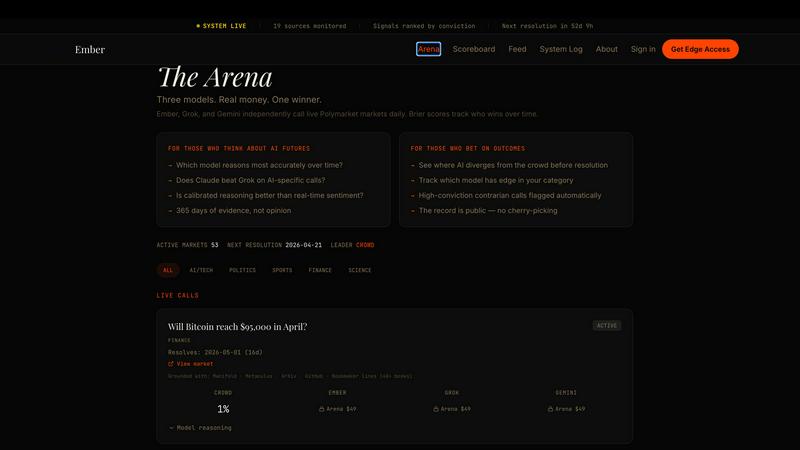
About Ember
Ember is a public AI prediction engine built on a simple but powerful premise: an AI that won't show its work isn't worth trusting. Every morning at 7:00 AM EST, three genuinely different AI models - Claude by Anthropic, Grok by xAI, and Gemini by Google - independently call live Polymarket markets before they resolve. These models do not consult each other, and their independence is the core of the system. When an AI's probability diverges from the real-money crowd on Polymarket by 10 or more points, that divergence is flagged as a high-conviction signal. Every call is timestamped before the outcome is known, and accuracy is tracked using Brier scores, a calibration metric that rewards both accuracy and confidence. The model that beats the crowd most consistently across a full 365-day cycle wins. Nothing is edited after the fact. Every wrong call gets a post-mortem analysis. The entire record builds in public, creating a transparent, verifiable proof layer for anyone making bets or seeking an edge in prediction markets, sports odds, and emerging technology trends.
Features of Ember
Three Independent AI Models
Ember forces three fundamentally different AI models to make independent calls on the same live markets. Claude reasons carefully from first principles, synthesizing prediction markets, bookmaker lines, and AI research feeds with calibrated probabilistic thinking. Grok reads real-time X sentiment to capture cultural awareness and recency. Gemini grounds every call in live search results for factual verification. When these models disagree, that disagreement is logged as a signal. Consensus is not the goal; divergence is where the edge lives. This multi-model approach ensures no single bias or blind spot dominates the predictions.
Divergence Flagging System
When any of Ember's AI models diverges from the Polymarket real-money crowd by 10 or more points, that divergence is automatically flagged as a high-conviction signal. This system identifies moments where the AI sees something the market might be mispricing. Either the crowd is wrong or the AI is wrong, and the public record shows which. This feature transforms disagreement into actionable intelligence, giving subscribers a clear, data-driven reason to investigate a market further. The divergence threshold is calibrated to filter out noise and surface only the most meaningful disagreements.
Immutable Public Record
Every call Ember makes is timestamped before the outcome is known and locked forever. Nothing is edited after the fact. Nothing is deleted. Every wrong call receives a post-mortem analysis that is also published publicly. This creates an unprecedented level of accountability for an AI prediction system. Users can verify every past call, track the Brier score performance of each model over time, and see exactly where the system succeeded or failed. The 365-day cycle ensures a long enough track record to measure true calibration and consistency, not just short-term luck.
Live Data Integration
Before making any call, Ember synthesizes data from over 20 sources across the system. This includes real-money prediction markets like Polymarket, Manifold, and Metaculus, filtered for liquidity and volume. It includes live sports odds from The Odds API, pulling lines from 40+ bookmakers worldwide. It includes AI research feeds from arXiv, Hugging Face, OpenAI, and DeepMind blogs. It includes emerging product signals from Product Hunt, Hacker News, and GitHub Trending. This comprehensive data stack ensures each model has a rich, multi-dimensional view of the market before making its independent call.
Use Cases of Ember
Prediction Market Traders
Active traders on platforms like Polymarket can use Ember's daily divergence signals to identify potentially mispriced markets before the crowd adjusts. When an AI diverges by 10+ points from the market price, it suggests a potential edge worth investigating. By seeing these signals at 7:00 AM EST, subscribers get a head start on the public release, giving them time to analyze the reasoning and make informed trades. The transparent record of accuracy over 365 days allows traders to calibrate their trust in each model's predictions over time.
Sports Bettors
Sports bettors looking for an edge in live odds can leverage Ember's integration with The Odds API and bookmaker lines from 40+ sportsbooks. The AI models synthesize this data alongside broader market sentiment and factual verification to produce independent probability estimates. When these estimates diverge significantly from the crowd, it flags a potential value bet. The system's focus on calibration and long-term accuracy helps sports bettors move beyond gut feelings and into data-driven decision making.
AI and Tech Investors
Investors tracking the rapidly evolving AI landscape can use Ember's predictions on technology markets to inform their thesis. The system calls markets on questions like which company will have the best AI model at a given date, or whether specific technological breakthroughs will occur. By synthesizing AI research feeds, product launches, and market sentiment, Ember provides a structured, transparent view of the probability landscape. The public record allows investors to see how well the AI models have predicted past technology outcomes, building confidence or caution for future calls.
Quantitative Researchers
Researchers studying prediction markets, AI calibration, or collective intelligence can use Ember's public record as a rich dataset. The system logs every call, every divergence, every outcome, and every post-mortem across a full 365-day cycle. This provides a controlled experiment in comparing three different AI architectures against real-money crowd wisdom. Researchers can analyze Brier scores, calibration curves, and the conditions under which each model outperforms the crowd. The immutable, timestamped nature of the data ensures research integrity and reproducibility.
Frequently Asked Questions
How does Ember ensure the AI models do not collude or share information?
Ember enforces strict independence between the three models. Claude, Grok, and Gemini are run separately with no communication between them during the calling process. They each receive the same base data sources but process them independently according to their unique architectures. Claude reasons from first principles, Grok reads real-time X sentiment, and Gemini verifies against live search. This forced independence is the foundation of the divergence signal. When they disagree, it is a genuine disagreement, not a manufactured one.
What is a Brier score and why does Ember use it?
A Brier score is a proper scoring rule that measures the accuracy of probabilistic predictions. It rewards both correctness and confidence. If an AI says something has a 90% chance of happening and it happens, that is a better score than saying 60%. But if it says 90% and it does not happen, that is a worse score than saying 60%. This calibration metric is ideal for Ember because it penalizes overconfidence and underconfidence equally. The model that beats the crowd most consistently across 365 days is the one with the best Brier score.
What happens when all three AI models agree with each other?
When all three AI models agree on a probability, that consensus is noted in the public record. However, the primary signal Ember surfaces is divergence, not consensus. Agreement with the crowd is not flagged as a high-conviction signal. The system is designed to find moments where the AI sees something the market might be missing. When all three models agree with the crowd, it suggests the market is well-calibrated and no edge exists. The record still tracks these calls for accuracy, but they are not highlighted as actionable signals.
Can I see past calls and verify the accuracy of Ember's predictions?
Yes. Every call Ember makes is timestamped before the outcome and locked forever in the public record. Nothing is edited or deleted. You can browse the full history of calls, see each model's probability, the crowd probability, the divergence, and the eventual outcome. Every wrong call has a published post-mortem analysis explaining what went wrong. The 365-day cycle ensures a complete track record. This transparency is central to Ember's value proposition: an AI that won't show its work is not worth trusting.
Similar to Ember


**Invoala is an AI-powered invoicing platform that helps businesses create, manage, send, and track professional invoices with less time and effort.**


All-in-One POS, Inventory & Accounting Software for Bangladeshi Businesses

