
Gaffa vs qtrl.ai
Side-by-side comparison to help you choose the right product.

Gaffa's API evolves to simplify web scraping and browser automation at any scale.
Last updated: March 1, 2026

qtrl.ai
qtrl.ai empowers QA teams to scale testing with AI while maintaining control, governance, and seamless integration.
Last updated: March 4, 2026
Visual Comparison
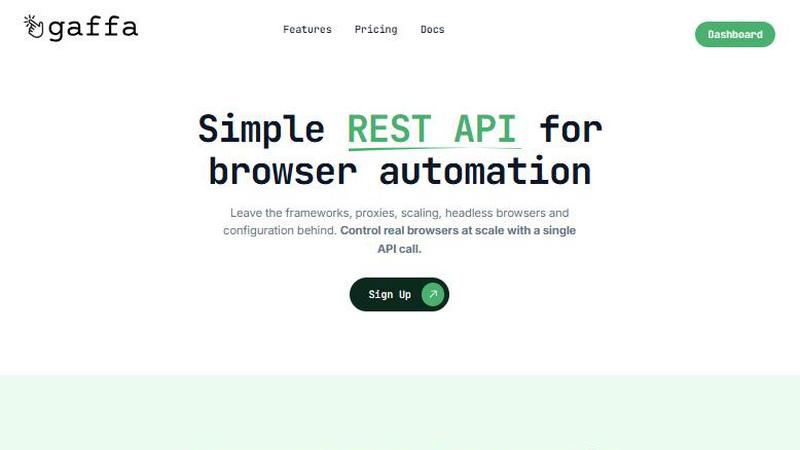
Gaffa
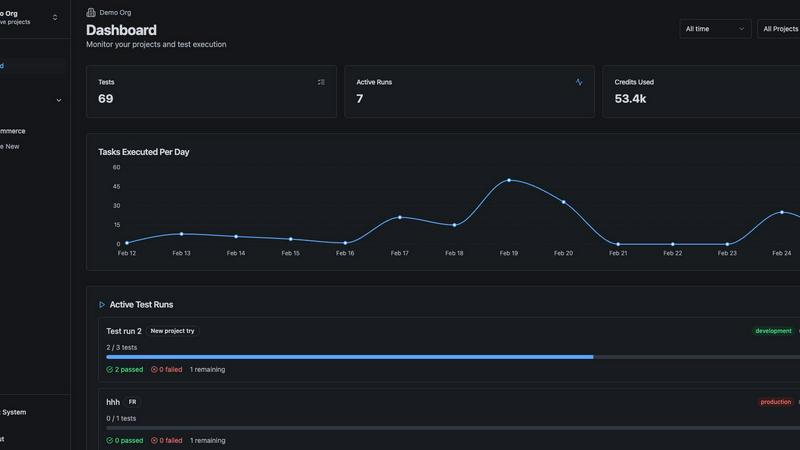
qtrl.ai
Feature Comparison
Gaffa
Simple REST API
Gaffa eliminates the steep learning curve associated with traditional browser automation frameworks like Playwright or Selenium. By abstracting their complex functionalities into a straightforward REST API, developers can initiate and control real browser sessions with a single HTTP call. This framework-free approach dramatically reduces development time and complexity, allowing you to build and iterate on your web automation projects faster and more efficiently, focusing on logic rather than configuration.
Ready-to-Scale Infrastructure
Scaling a web data project presents significant challenges in resource management and reliability. Gaffa's architecture is built from the ground up to handle these demands effortlessly. The platform manages all the underlying complexities, including concurrent request handling, proxy rotation, and performance optimization. This means you can scale your data extraction operations from a few requests to millions without worrying about infrastructure, ensuring your projects grow smoothly and reliably.
Real Browser Automation with Proxies
Gaffa uses real, fully-featured browsers to execute your automations, ensuring perfect JavaScript rendering and avoiding the quirks of headless browsers. Every action is performed exactly as a human would do it. Coupled with a seamlessly integrated global network of residential proxies, you can specify geographic locations for your requests, ensuring fast, reliable, and geographically targeted access to web data without the hassle of managing proxy providers yourself.
Advanced Data Processing & Observability
Gaffa goes beyond simply fetching raw HTML. It includes built-in data processing capabilities to deliver the information you need in the most usable format, whether that's simplified HTML, LLM-ready markdown, or a self-contained offline page. Furthermore, full observability is provided through session recording, allowing you to visually replay every automation. This transparency is crucial for debugging, verifying data accuracy, and continuously improving your automation scripts.
qtrl.ai
Autonomous QA Agents
qtrl.ai's autonomous QA agents execute testing instructions on demand or continuously, enabling teams to run tests across various environments at scale. This feature ensures real browser execution rather than simulations, maintaining the integrity of test results and operational efficiency.
Enterprise-Grade Test Management
With comprehensive capabilities for centralized test case management, qtrl.ai provides full traceability and audit trails. It supports both manual and automated workflows, making it an ideal solution for organizations that prioritize compliance and need robust oversight in their QA processes.
Progressive Automation
Starting with human-written test instructions, qtrl.ai allows teams to enhance their automation gradually. As teams become more comfortable, they can transition to AI-generated tests. The platform intelligently suggests new tests based on coverage gaps, ensuring that quality assurance evolves alongside the application.
Adaptive Memory
qtrl.ai builds a living knowledge base of your application through its adaptive memory feature. This allows the platform to learn from exploration, test execution, and encountered issues, ultimately powering smarter and more context-aware test generation that improves with each interaction.
Use Cases
Gaffa
Large-Scale Web Scraping and Data Aggregation
Businesses in market research, competitive intelligence, and price monitoring require vast amounts of accurate, timely data from across the web. Gaffa automates this extraction at scale, handling thousands of targets simultaneously with its robust proxy network and anti-detection measures. This enables companies to build comprehensive datasets for analysis without the operational burden of maintaining fragile scraping infrastructure, turning web data into a consistent, reliable asset.
Automated Testing and Quality Assurance
For development teams, ensuring a web application works flawlessly across different scenarios is a continuous cycle of testing. Gaffa can automate complex user journeys and interactions in real browsers for QA purposes. Its ability to record sessions provides perfect reproducibility for bug reporting, and its scalable nature allows for running extensive test suites in parallel, significantly accelerating the development feedback loop and improving software quality iteratively.
Content Monitoring and Archival
Organizations needing to monitor regulatory updates, news, or digital content changes can use Gaffa to schedule regular, automated visits to target web pages. The service can capture screenshots, save self-contained offline versions, or extract specific content into structured formats. This creates a reliable, automated audit trail and archival system, ensuring critical web-based information is never missed and is stored in a processable format for future reference.
AI and LLM Data Pipeline Preparation
Training and fine-tuning large language models (LLMs) require massive, clean datasets often sourced from the web. Gaffa's ability to extract and process pages directly into LLM-ready markdown format is invaluable. It automates the collection and preprocessing of web content, removing boilerplate and formatting noise, thereby creating high-quality, structured text corpora efficiently. This accelerates the data preparation phase, allowing AI teams to focus on model development and refinement.
qtrl.ai
Product-Led Engineering Teams
For product-led engineering teams, qtrl.ai provides the tools to streamline testing processes, enabling faster releases without sacrificing quality. Teams can manage their test cases effectively while leveraging automation to enhance efficiency.
QA Teams Scaling Beyond Manual Testing
QA teams transitioning from manual testing to automated processes can utilize qtrl.ai to scale their efforts. The platform facilitates a gradual shift, allowing teams to maintain control while adopting new technologies at their own pace.
Companies Modernizing Legacy QA Workflows
Organizations looking to modernize their legacy QA workflows can benefit from qtrl.ai's robust features. The platform integrates seamlessly with existing tools and processes, providing a pathway to improved testing and quality assurance practices.
Enterprises Requiring Governance and Traceability
For enterprises that must adhere to strict governance and compliance standards, qtrl.ai ensures full visibility and traceability across all testing activities. This makes it easier to maintain audit trails and meet regulatory requirements while scaling QA efforts.
Overview
About Gaffa
In the dynamic landscape of web data, the challenge isn't just about extraction; it's about building a reliable, scalable, and maintainable system that evolves with your needs. Gaffa is the answer to this continuous cycle of improvement. It is an innovative API designed to simplify and supercharge web data extraction and browser automation, allowing developers, data analysts, and businesses to break free from the endless maintenance of complex scraping pipelines. Gaffa's core value proposition is its ability to abstract away the formidable technical hurdles—such as managing headless browsers, configuring proxies, solving CAPTCHAs, and ensuring seamless scalability—so your team can focus on deriving insights and building your core product. By providing a simple, framework-free REST API, Gaffa empowers you to control real browsers at scale with a single call, ensuring JavaScript rendering by default and human-like interactions. This commitment to simplification is matched by a robust architecture that grows with you, handling whatever volume you throw at it while offering advanced data processing and full observability. With Gaffa, you're not just accessing data; you're adopting a partner in your journey of iterative growth and continuous operational refinement.
About qtrl.ai
qtrl.ai is a cutting-edge quality assurance platform tailored for software development teams seeking to enhance their testing processes without compromising control or governance. This innovative tool merges robust test management capabilities with intelligent AI-driven automation, creating a centralized hub for organizing test cases, planning test runs, and tracking quality metrics through real-time dashboards. qtrl.ai's architecture is designed to provide clear visibility into testing progress, pass rates, and potential risk areas, making it invaluable for engineering leads and QA managers alike. Unlike traditional automation tools that can be brittle and complex, qtrl.ai offers a progressive transition from manual to automated testing, ensuring teams can scale their QA efforts at their own pace. By leveraging qtrl.ai, product-led engineering teams, QA groups moving beyond manual processes, and enterprises needing strict compliance can experience a smoother, more efficient path to quality assurance.
Frequently Asked Questions
Gaffa FAQ
What is a credit and how is it calculated?
Credits are Gaffa's unit of consumption for its API. They are calculated based on two primary factors: request time and proxy usage. Browser request time is billed at 1 credit per 30 seconds (or 2 credits per 30 seconds if screen recording is enabled). Additionally, any request using a residential proxy (proxy_location parameter) consumes 1500 credits per 1GB of bandwidth used. Each successful API call deducts the corresponding credits from your monthly allowance.
Does Gaffa offer a free trial?
Yes, Gaffa provides a comprehensive free tier that allows you to experiment with all core API features. You can sign up and immediately start building automations that run on our dedicated demo site (demo.gaffa.dev). This sandbox environment lets you fully test the API's capabilities, from browser control to data processing, without any cost or credit card required, before upgrading to a paid plan for use on the live web.
What is Gaffa's refund policy?
Gaffa is committed to customer satisfaction. We are happy to offer a full refund for your current billing period if you request it before using any of the credits allocated for that month. This policy is designed to give you confidence when upgrading to a paid plan, ensuring you only pay for the service if it meets your needs as you integrate and test it within your own workflows.
Do unused credits roll over to the next month?
No, credits do not roll over from one billing cycle to the next. The credit allowances included in your monthly subscription plan (Starter, Startup, Growth) are reset at the start of each new billing period. This model encourages the continuous and efficient use of the service within your operational cycle. For consistent high-volume needs, our pay-as-you-go credit packs or custom enterprise plans are recommended.
qtrl.ai FAQ
What makes qtrl.ai different from traditional QA tools?
qtrl.ai stands apart with its combination of enterprise-grade test management and intelligent AI automation. It allows teams to scale their testing efforts progressively while maintaining control, unlike traditional tools that can be brittle and complex.
How does qtrl.ai support compliance and auditability?
qtrl.ai is designed with governance in mind, offering full traceability and audit trails for all test cases and runs. This ensures that enterprises can easily meet compliance requirements and maintain oversight throughout the QA process.
Can teams start with manual testing and transition to automation?
Yes, qtrl.ai supports a progressive approach to testing. Teams can begin with manual test management and gradually adopt AI-generated tests when they feel ready, ensuring a smooth transition without overwhelming changes.
How does the adaptive memory feature work?
The adaptive memory feature in qtrl.ai builds a continuous knowledge base of your application by learning from interactions, test executions, and issues encountered. This improves the platform's ability to generate context-aware tests, making it more effective over time.
Alternatives
Gaffa Alternatives
Gaffa is a powerful tool in the productivity and management category, designed to simplify web scraping and browser automation. It provides a single API to control real browsers, handling the complexities of proxies, scaling, and data extraction so teams can focus on insights rather than infrastructure. Users often explore alternatives to find a solution that aligns perfectly with their specific needs. This could be due to budget constraints, a requirement for different technical features, or the need to integrate with a particular platform or workflow. The search for the right tool is a natural part of refining a data strategy. When evaluating options, consider the core capabilities that matter most to your projects. Look for reliable performance, ease of use, and transparent pricing. The goal is to select a platform that not only meets your current demands but also supports continuous improvement and can scale alongside your evolving data requirements.
qtrl.ai Alternatives
qtrl.ai is a cutting-edge quality assurance platform that empowers software teams to enhance their testing processes through the integration of AI agents while maintaining full control and governance. Positioned within the automation and dev tools category, qtrl.ai is particularly valuable for QA teams looking to streamline their testing workflows without compromising on oversight or compliance. Users often seek alternatives to qtrl.ai for various reasons, such as pricing considerations, specific feature requirements, or platform compatibility issues. When exploring alternatives, it's essential to evaluate factors such as the flexibility of automation options, the ease of integration with existing tools, and the overall user experience. Additionally, look for solutions that offer robust test management capabilities alongside effective AI support, ensuring that the chosen platform aligns with your team's unique needs and goals. Finding the right alternative can significantly influence your quality assurance strategy and drive continuous improvement.