
Gaffa vs Playwriter
Side-by-side comparison to help you choose the right product.

Gaffa's API evolves to simplify web scraping and browser automation at any scale.
Last updated: March 1, 2026

Playwriter
Playwriter lets AI agents control your real Chrome browser with all your logins and extensions intact.
Last updated: March 18, 2026
Visual Comparison
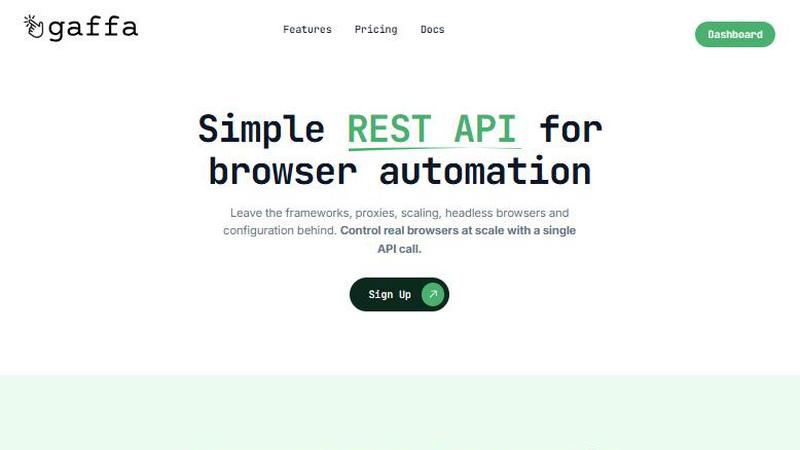
Gaffa
Playwriter

Feature Comparison
Gaffa
Simple REST API
Gaffa eliminates the steep learning curve associated with traditional browser automation frameworks like Playwright or Selenium. By abstracting their complex functionalities into a straightforward REST API, developers can initiate and control real browser sessions with a single HTTP call. This framework-free approach dramatically reduces development time and complexity, allowing you to build and iterate on your web automation projects faster and more efficiently, focusing on logic rather than configuration.
Ready-to-Scale Infrastructure
Scaling a web data project presents significant challenges in resource management and reliability. Gaffa's architecture is built from the ground up to handle these demands effortlessly. The platform manages all the underlying complexities, including concurrent request handling, proxy rotation, and performance optimization. This means you can scale your data extraction operations from a few requests to millions without worrying about infrastructure, ensuring your projects grow smoothly and reliably.
Real Browser Automation with Proxies
Gaffa uses real, fully-featured browsers to execute your automations, ensuring perfect JavaScript rendering and avoiding the quirks of headless browsers. Every action is performed exactly as a human would do it. Coupled with a seamlessly integrated global network of residential proxies, you can specify geographic locations for your requests, ensuring fast, reliable, and geographically targeted access to web data without the hassle of managing proxy providers yourself.
Advanced Data Processing & Observability
Gaffa goes beyond simply fetching raw HTML. It includes built-in data processing capabilities to deliver the information you need in the most usable format, whether that's simplified HTML, LLM-ready markdown, or a self-contained offline page. Furthermore, full observability is provided through session recording, allowing you to visually replay every automation. This transparency is crucial for debugging, verifying data accuracy, and continuously improving your automation scripts.
Playwriter
Your Authenticated Browser Session
Playwriter's core feature is granting AI agents access to your real Chrome browser. This eliminates the barriers of headless instances or fresh profiles. Your existing sessions, saved logins, cookies, and even installed extensions like password managers or ad blockers are all present. This not only bypasses common bot detection mechanisms but also saves significant memory since it doesn't require spawning a duplicate browser process. The agent operates in an environment that truly reflects a real user's state, making automation of logged-in workflows seamless and effective.
Full Playwright API via a Single Tool
Unlike other solutions that expose a limited, fixed set of predefined tools, Playwriter provides the entire powerful Playwright automation library through one simple execute command. This means your AI agent can write and run any Playwright code—clicking, typing, navigating, waiting for elements, extracting data, and more. This approach avoids "schema bloat" from dozens of individual tool definitions, drastically reducing context window usage in AI models and giving the agent maximum flexibility to solve complex browsing tasks without artificial constraints.
Advanced Debugging and Inspection Suite
Playwriter transforms your browser into a fully debuggable environment for AI agents. It includes a sophisticated debugger that allows setting breakpoints to pause execution, live editing of the running Playwright code for on-the-fly adjustments, and network request interception to monitor or modify API calls. This suite enables a truly iterative development cycle where the agent can profile performance, diagnose issues, and refine its approach in real-time, leading to more robust and reliable automation scripts.
Lightweight Accessibility Snapshots & Recording
Instead of relying on bulky, bandwidth-intensive full-page screenshots, Playwriter captures intelligent, structured accessibility snapshots. These snapshots are incredibly small (5-20KB) and contain the semantic structure of the page, including roles, labels, and relationships, which AI agents can parse far more efficiently than pixel data. Coupled with optional full video recording of sessions, this provides perfect context for both the AI and the human collaborator to understand what happened during an automation run, facilitating review and continuous improvement.
Use Cases
Gaffa
Large-Scale Web Scraping and Data Aggregation
Businesses in market research, competitive intelligence, and price monitoring require vast amounts of accurate, timely data from across the web. Gaffa automates this extraction at scale, handling thousands of targets simultaneously with its robust proxy network and anti-detection measures. This enables companies to build comprehensive datasets for analysis without the operational burden of maintaining fragile scraping infrastructure, turning web data into a consistent, reliable asset.
Automated Testing and Quality Assurance
For development teams, ensuring a web application works flawlessly across different scenarios is a continuous cycle of testing. Gaffa can automate complex user journeys and interactions in real browsers for QA purposes. Its ability to record sessions provides perfect reproducibility for bug reporting, and its scalable nature allows for running extensive test suites in parallel, significantly accelerating the development feedback loop and improving software quality iteratively.
Content Monitoring and Archival
Organizations needing to monitor regulatory updates, news, or digital content changes can use Gaffa to schedule regular, automated visits to target web pages. The service can capture screenshots, save self-contained offline versions, or extract specific content into structured formats. This creates a reliable, automated audit trail and archival system, ensuring critical web-based information is never missed and is stored in a processable format for future reference.
AI and LLM Data Pipeline Preparation
Training and fine-tuning large language models (LLMs) require massive, clean datasets often sourced from the web. Gaffa's ability to extract and process pages directly into LLM-ready markdown format is invaluable. It automates the collection and preprocessing of web content, removing boilerplate and formatting noise, thereby creating high-quality, structured text corpora efficiently. This accelerates the data preparation phase, allowing AI teams to focus on model development and refinement.
Playwriter
AI-Powered Web Testing and QA
Enable your AI assistant to perform automated, real-user testing directly in your production-like browser environment. It can log into your web application, navigate complex user journeys, fill out forms, and validate outcomes—all while using your actual session data. This cyclical process allows for continuous test script improvement as the AI learns from each interaction, and you can step in to handle unexpected UI changes or captchas, creating a powerful human-in-the-loop testing pipeline.
Automated Data Extraction and Research
Instruct your AI agent to conduct web research or monitor websites for specific information. Because it uses your logged-in browser, it can access subscription-based content, private dashboards, or personalized feeds that are impossible for a fresh bot to reach. The agent can iteratively refine its extraction logic based on the structure of the snapshots it receives, and you can collaborate by solving paywalls or login prompts it encounters, making data gathering effortless and comprehensive.
Repetitive Task Automation and Workflows
Offload tedious, repetitive web tasks to your AI agent. This could include daily reporting from a business dashboard, routine content moderation on a platform, or automated form submissions. Playwriter allows the agent to perform these tasks within the exact browser context you use, ensuring all your preferences and settings are applied. The iterative nature means you can gradually teach the agent to handle more complex sequences and edge cases, building a more capable assistant over time.
Building and Refining AI Web Skills
Use Playwriter as a development platform for creating and honing AI "skills" for web interaction. Developers can work alongside an AI to write, test, and debug Playwright scripts in a real browser. The live code editing and debugger features are perfect for this collaborative, cyclical development process. You can rapidly prototype an automation, see exactly where it fails, adjust the strategy with the AI, and re-run it, leading to the continuous improvement of sophisticated web automation capabilities.
Overview
About Gaffa
In the dynamic landscape of web data, the challenge isn't just about extraction; it's about building a reliable, scalable, and maintainable system that evolves with your needs. Gaffa is the answer to this continuous cycle of improvement. It is an innovative API designed to simplify and supercharge web data extraction and browser automation, allowing developers, data analysts, and businesses to break free from the endless maintenance of complex scraping pipelines. Gaffa's core value proposition is its ability to abstract away the formidable technical hurdles—such as managing headless browsers, configuring proxies, solving CAPTCHAs, and ensuring seamless scalability—so your team can focus on deriving insights and building your core product. By providing a simple, framework-free REST API, Gaffa empowers you to control real browsers at scale with a single call, ensuring JavaScript rendering by default and human-like interactions. This commitment to simplification is matched by a robust architecture that grows with you, handling whatever volume you throw at it while offering advanced data processing and full observability. With Gaffa, you're not just accessing data; you're adopting a partner in your journey of iterative growth and continuous operational refinement.
About Playwriter
Playwriter is a revolutionary open-source tool that bridges the gap between AI agents and the real web. It solves the fundamental problem where AI agents either have no browser access or are forced to use a fresh, sterile browser instance with no logins, no extensions, and instant bot detection. Instead, Playwriter gives AI agents direct, programmable control over your actual, authenticated Chrome browser session. This means the agent works within a browser that already has all your cookies, logins, installed extensions, and user profile, making its actions indistinguishable from a human user. It provides a full Playwright automation API through a simple Chrome extension and CLI, enabling sophisticated tasks like taking lightweight accessibility snapshots, debugging with breakpoints, live code editing, intercepting network requests, and recording video. Designed for a cyclical and iterative workflow, Playwriter fosters continuous improvement by allowing seamless collaboration between human and AI, where the agent handles repetitive automation and the human steps in to guide it through complex hurdles. It's built for developers, QA engineers, and power users working with AI coding assistants in Cursor, Claude Desktop, VS Code, and other MCP clients who need their agents to interact with the web as they do.
Frequently Asked Questions
Gaffa FAQ
What is a credit and how is it calculated?
Credits are Gaffa's unit of consumption for its API. They are calculated based on two primary factors: request time and proxy usage. Browser request time is billed at 1 credit per 30 seconds (or 2 credits per 30 seconds if screen recording is enabled). Additionally, any request using a residential proxy (proxy_location parameter) consumes 1500 credits per 1GB of bandwidth used. Each successful API call deducts the corresponding credits from your monthly allowance.
Does Gaffa offer a free trial?
Yes, Gaffa provides a comprehensive free tier that allows you to experiment with all core API features. You can sign up and immediately start building automations that run on our dedicated demo site (demo.gaffa.dev). This sandbox environment lets you fully test the API's capabilities, from browser control to data processing, without any cost or credit card required, before upgrading to a paid plan for use on the live web.
What is Gaffa's refund policy?
Gaffa is committed to customer satisfaction. We are happy to offer a full refund for your current billing period if you request it before using any of the credits allocated for that month. This policy is designed to give you confidence when upgrading to a paid plan, ensuring you only pay for the service if it meets your needs as you integrate and test it within your own workflows.
Do unused credits roll over to the next month?
No, credits do not roll over from one billing cycle to the next. The credit allowances included in your monthly subscription plan (Starter, Startup, Growth) are reset at the start of each new billing period. This model encourages the continuous and efficient use of the service within your operational cycle. For consistent high-volume needs, our pay-as-you-go credit packs or custom enterprise plans are recommended.
Playwriter FAQ
How does Playwriter differ from a traditional headless browser?
Traditional headless browsers or automation tools spawn a completely new, isolated browser instance with no user data, making them easily detectable as bots and unable to access logged-in services. Playwriter is fundamentally different: it connects an AI agent directly to your existing, open Chrome browser. This means it leverages your real cookies, local storage, extensions, and user agent, allowing automation that perfectly mimics human behavior and accesses all the websites you're already signed into.
Is my browsing data sent to a remote server?
No. Playwriter is designed with privacy and security as a priority. All communication happens locally on your machine. The Chrome extension connects to a small WebSocket relay running on localhost:19988. Your AI client (CLI or MCP server) also connects to this local relay. All commands and data, including CDP instructions and snapshots, flow through this local loop. No data is sent to any remote server, and no account is required.
What happens if the AI gets stuck or hits a captcha?
This is where Playwriter's collaborative, cyclical workflow shines. You are sharing the browser with the agent in real-time. If a captcha, consent wall, or unexpected modal appears, you can simply look at your browser tab and solve it yourself. Once the obstacle is cleared, you re-enable the extension for that tab, and the AI agent can continue its task from where it left off. This human-in-the-loop approach is core to handling the dynamic nature of the modern web.
Can I use Playwriter with any AI assistant?
Yes, Playwriter is compatible with any client that supports the Model Context Protocol (MCP), which is becoming a standard for AI tool integration. This includes popular coding assistants like Cursor, Claude Desktop, Windsurf, and IDEs with MCP plugins like VS Code. The provided "skill" teaches these agents how to effectively use the Playwriter API, including best practices for selectors and handling timeouts, making it a versatile tool for any MCP-enabled AI.
Alternatives
Gaffa Alternatives
Gaffa is a powerful tool in the productivity and management category, designed to simplify web scraping and browser automation. It provides a single API to control real browsers, handling the complexities of proxies, scaling, and data extraction so teams can focus on insights rather than infrastructure. Users often explore alternatives to find a solution that aligns perfectly with their specific needs. This could be due to budget constraints, a requirement for different technical features, or the need to integrate with a particular platform or workflow. The search for the right tool is a natural part of refining a data strategy. When evaluating options, consider the core capabilities that matter most to your projects. Look for reliable performance, ease of use, and transparent pricing. The goal is to select a platform that not only meets your current demands but also supports continuous improvement and can scale alongside your evolving data requirements.
Playwriter Alternatives
Playwriter is an AI-powered browser automation tool that gives AI agents direct, authenticated control over your actual Chrome session. It solves the core problem of agents working in isolated, fresh browser instances with no logins, extensions, or session history, which often triggers bot detection and limits functionality. This places it in the automation category, specifically for bridging AI and real-world web interaction. Users explore alternatives for various reasons. Some may seek different pricing models, from one-time purchases to varied subscription tiers. Others might need specific features Playwriter doesn't emphasize, require support for browsers other than Chrome, or look for a solution integrated into a different platform or workflow. The specific needs of a project or team can drive this search. When evaluating options, key considerations include the depth of browser integration and session persistence, the quality of debugging and developer tools, compatibility with your existing AI agent clients, and the overall philosophy regarding open-source licensing and security. The goal is to find a tool that not only automates but does so intelligently within the context of your established digital environment.