
Serro AI
Serro AI creates a live shared memory for your teams, continuously syncing tools and programs so coordination scales with your output.
Visit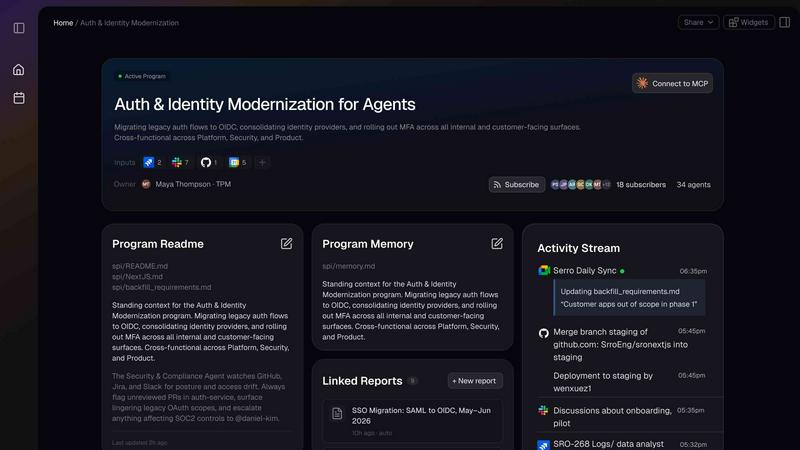
About Serro AI
Serro AI is the first infrastructure purpose-built for the Technical Program Management (TPM) function, acting as an Agentic TPM that transforms how engineering organizations coordinate work. Unlike traditional task trackers, roadmap tools, documentation wikis, dashboards, or generic project management platforms, Serro treats programs as first-class units of work. It ingests scattered execution signals from tools like Jira, GitHub, Linear, Slack, docs, meetings, and roadmaps, then synthesizes them into two critical outputs: trusted temporal program memory and real-time status coordination. The program memory is a living record of shared goals, decisions, risks, dependencies, and historical context that stays current automatically as work progresses. The coordination layer enables both humans and AI agents to act on the same up to date understanding of organizational reality. Serro is built for Technical Program Managers, Engineering Managers, Product Managers, and engineering leaders who need to scale their coordination capacity without adding overhead. It comes in two editions: Serro Pro helps enterprises scale existing TPM capacity so teams can collaboratively manage downstream program execution and agent loops, while Serro Lite gives earlier stage companies AI powered TPM capacity much sooner, enabling smaller teams to scale their live coordination. The product meets teams where they already work, allowing users to speak to it in meetings, message it in chat, and command it from their existing tools. Serro is built by operators in the USA for the next generation of engineering teams where human expertise defines direction and AI accelerates execution.
Features of Serro AI
Program Memory
Serro maintains live memory across every active program, automatically capturing decisions, risks, owners, history, and activity as work moves. This eliminates the need for manual documentation and status updates. Instead of reconstructing context after the fact, teams have a continuously updated, trusted temporal record of shared goals, dependencies, and past decisions. The memory acts as a single source of truth that both humans and AI agents can reference, ensuring alignment across cross functional teams and preventing coordination drift over time.
Loops on Programs
Serro runs loops that keep complex work moving by automating coordination workflows and follow through actions. These loops monitor program execution signals, detect blockers, and trigger status updates or escalation paths without manual intervention. Teams can set up cadenced reporting, automated dependency tracking, and action item generation from meeting outcomes. The loops ensure that nothing falls through the cracks, enabling continuous progress even when team members are working asynchronously across different tools and time zones.
Agent Governance
Serro provides a control layer for programs and agents, ensuring that AI driven execution stays aligned with human intent and organizational policies. This feature governs how agents interact with program memory, what actions they can take, and when human approval is required. It prevents agents from making unauthorized changes or creating coordination noise while still allowing them to accelerate routine tasks like status updates, risk flagging, and dependency resolution. The governance layer is calibrated for high velocity work environments where speed must be balanced with control.
Program Analytics
Serro offers a system level view across the organization, transforming fragmented updates into a live picture of program health. Leadership can see momentum, blockers, coordination gaps, and operational risk in real time. The analytics surface patterns across programs, helping teams identify bottlenecks before they become critical. Metrics include program velocity, decision latency, dependency resolution times, and coordination efficiency. This enables faster, data driven decisions about resource allocation, priority shifts, and strategic adjustments across the entire program portfolio.
Use Cases of Serro AI
Technical Program Manager Scaling
TPMs use Serro to delegate coordination overhead and scale their impact across more cross functional programs. Instead of chasing status updates across Jira, Slack, and email, TPMs get a live view of timelines, blockers, ownership, and reporting in one place. Serro automatically captures decisions from meetings, generates status reports on cadence, and surfaces risks before they escalate. This allows TPMs to run more programs simultaneously without sacrificing visibility or control, turning coordination from a bottleneck into a force multiplier.
Engineering Manager Reality Checks
Engineering Managers use Serro to understand reality without chasing updates from their teams. The platform shows what is moving across teams, where execution is slipping, and what needs attention next. EMs stay close to delivery progress, risk exposure, and team health through a shared view of work that updates automatically as signals come in from GitHub, Linear, and other tools. This enables EMs to focus on coaching and technical decisions rather than spending hours reconstructing program status from scattered sources.
Product Manager Alignment
Product Managers use Serro to keep decisions, timelines, and execution aligned as priorities evolve. When roadmap shifts happen, Serro propagates the changes across connected programs, updating dependencies, owners, and timelines automatically. PMs can see how product direction ties to delivery progress, ensuring that strategic decisions are reflected in execution reality. The platform also captures decision rationale from Slack threads and meetings, creating an auditable trail that prevents misalignment when team members change or projects hand off.
Engineering Leadership Oversight
Engineering leaders and executives use Serro to see organizational health in real time. Instead of relying on weekly status decks, they get a live dashboard showing momentum across programs, coordination gaps between teams, and operational risk indicators. This enables faster, more informed decisions about resource reallocation, priority adjustments, and intervention points. Leaders can spot patterns across the portfolio, such as recurring bottlenecks or teams that are consistently over capacity, and take corrective action before those patterns impact delivery timelines.
Frequently Asked Questions
How does Serro differ from Jira, Asana, or other project management tools?
Serro is not a task tracker or project management platform. It is an Agentic TPM infrastructure that treats programs as first class units of work. While task trackers focus on individual tickets and assignments, Serro synthesizes signals across multiple tools including Jira, GitHub, Linear, Slack, docs, and meetings to create live program memory and coordination. It does not replace these tools; instead, it sits above them as a coordination layer that both humans and AI agents can act on.
Can Serro work with our existing tool stack?
Yes, Serro is designed to meet you where you already work. It connects to Slack, Linear, GitHub, Jira, Zoom, Notion, email, and your codebase. Once connected, it starts ingesting signals immediately and surfaces the programs you are running. You can speak to Serro in meetings, message it in chat, and command it from your tools. The platform adapts to your existing workflows rather than requiring you to adopt new processes.
How does Serro handle data security and privacy?
Serro takes security seriously as it is built for enterprise engineering teams. The platform provides a control layer for agent governance, ensuring that AI agents only take authorized actions and that human approval is required for sensitive changes. Serro is built by operators in the USA and follows industry standard security practices. For specific details about encryption, data residency, and compliance certifications, teams should review Serro's security documentation or contact the partnership team.
What is the difference between Serro Pro and Serro Lite?
Serro Pro is designed for enterprises that need to scale existing TPM capacity. It enables TPMs, EMs, PMs, and engineering leaders to collaboratively manage downstream program execution and agent loops across large organizations. Serro Lite gives earlier stage companies AI powered TPM capacity much sooner, allowing smaller teams to scale their live coordination without needing dedicated program management staff. Both editions provide the same core program memory and coordination capabilities but are calibrated for different team sizes and maturity levels.
Similar to Serro AI

Moderation, routing, intent and scoring for any text over one Jev-compatible API, hosted in the EU.


a SaaS solution that scores any website for AI agent readiness, MCP server security, and Domain Rating.


A directory of AI tools where a person used each one first.

AI transcription for voice notes, meetings, and audio files in 1,700 languages, with AI summaries and subtitle export and unlimited chat ai usage.

AI sales agent that finds qualified leads, runs outreach, follows up automatically, creates content, and helps book more meetings.