
Kompy
Build smarter agents and apps with clean Walmart price, stock, seller, and review data you can iterate on daily.
Visit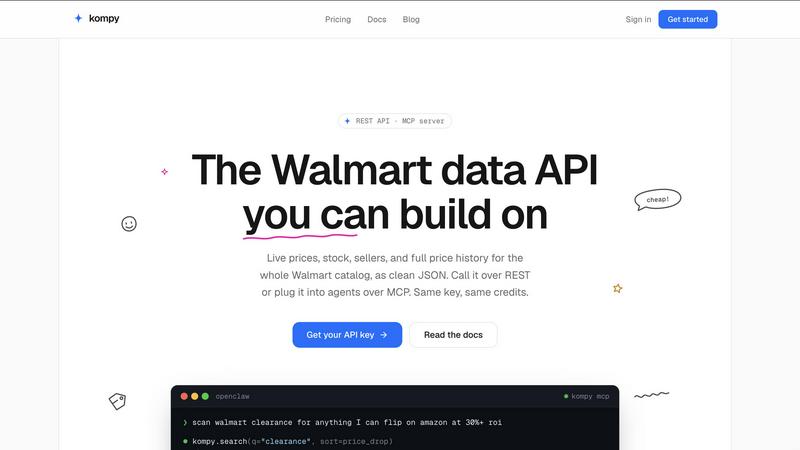
About Kompy
Kompy is a unified ecommerce data API that provides structured Walmart marketplace data without the complexity of running and maintaining your own scrapers. It delivers products, search results, barcode lookups, seller offers, customer reviews, and full price and stock history through a single, clean REST API. Every response is returned as consistent, predictable JSON, making it immediately usable in any application, script, or workflow. Kompy is built for both humans and machines: developers can call the REST API from any programming language, while AI agents can be pointed directly at the Kompy MCP server to query Walmart data as callable tools. The platform is designed to be iterative, allowing you to start with a simple curl command or a single agent query and then continuously improve your integrations as your needs grow. From side projects checking a few products to production systems tracking thousands of SKUs, Kompy scales with you. It offers Google sign-in for instant onboarding, immediate API key generation, and a credit-based pricing model that grows from hobbyist to enterprise without friction. Kompy records the marketplace around the clock, capturing hourly snapshots of prices, stock levels, and buy-box changes for every tracked SKU, storing the full history back to day one. This cyclical data collection means you can always look back, analyze trends, and make better decisions with every iteration of your workflow. Whether you are a solo developer, a small team, or a large organization, Kompy gives you the Walmart data you can build on, refine, and continuously improve.
Features of Kompy
One API for the Entire Walmart Catalog
Kompy consolidates every major data point from Walmart into a single REST API endpoint. You can retrieve full product records including name, brand, price, currency, stock status, rating, review count, and seller information with one request. The same API handles product lookups, keyword searches with sorting and filtering, barcode scanning, seller offer details, customer reviews, and comprehensive price and stock history. This unified approach eliminates the need to cobble together multiple data sources or manage complex scraping pipelines. Every response follows a predictable JSON schema, making it easy to parse and integrate into any application. You can iterate on your integration quickly, starting with a simple product lookup and then layering in search, history, and reviews as your requirements evolve.
MCP Server for AI Agents
Kompy ships a first-party MCP (Model Context Protocol) server that turns every API operation into a callable tool for AI agents. Platforms like Claude Code, OpenClaw, Cursor, LangChain, OpenAI Agents SDK, and n8n can connect directly to the MCP server using a single API key. Agents can search the live catalog, retrieve full product records, pull per-seller price history, and fetch customer reviews as if they were native functions. This feature enables a cyclical workflow where you can ask your agent to scan for clearance items, analyze price drops, and identify profitable flips, all through natural language commands. The MCP server uses the same authentication and credit system as the REST API, so there is no separate setup or configuration. You can continuously refine your agent's prompts and queries to improve the quality and relevance of the data it retrieves.
Full Historical Price and Stock Data
Kompy records the Walmart marketplace around the clock, taking hourly snapshots of prices, stock levels, and buy-box changes for every SKU it tracks. This historical data is stored per seller and goes back to day one, giving you a complete timeline of every price movement and stock fluctuation. No other Walmart API offers this level of granularity and depth. You can query the history endpoint to see how a product's price evolved over weeks, months, or the entire year, identifying seasonal trends, flash sales, and clearance events. This feature is invaluable for price analysis, competitive research, and arbitrage opportunities. The cyclical nature of historical data means you can continuously improve your models and strategies as more data accumulates, turning each new snapshot into a richer understanding of the marketplace.
Clean, Predictable JSON Responses
Every API response from Kompy is structured as clean, consistent JSON with a deterministic schema. The response always includes a data object containing the requested information, such as product details, search results, or price history, and a meta object with metadata like a unique request_id and the latency_ms for the request. This predictable format makes it trivial to parse responses in any programming language or workflow. There are no SDKs required, though you can use them if you prefer. The small payloads and structured error messages mean you can quickly diagnose issues and iterate on your integration. Each response carries a traceable request ID, allowing you to monitor performance and debug problems with precision. This design encourages a continuous improvement cycle: you can refine your data processing logic, error handling, and caching strategies as you become more familiar with the API.
Use Cases of Kompy
Ecommerce Price Monitoring and Arbitrage
Developers and entrepreneurs can use Kompy to monitor Walmart prices in real time and identify profitable arbitrage opportunities. By combining the search, product, and history endpoints, you can scan for clearance items, track price drops, and compare Walmart prices against other marketplaces like Amazon. The historical data lets you see if a price drop is a genuine clearance event or a temporary fluctuation. You can build automated scripts that run hourly, checking for products that meet your margin thresholds, and receive alerts when a new flip becomes viable. This cyclical process of scanning, analyzing, and acting can be refined over time to focus on the most profitable categories and sellers, continuously improving your return on investment.
AI-Powered Shopping Assistants
With the MCP server, you can build AI agents that act as personal shopping assistants for Walmart. An agent can search for products based on natural language queries, retrieve detailed product information, check current prices and stock levels, and pull customer reviews to help make purchasing decisions. The agent can also track price history to advise on whether to buy now or wait for a better deal. Because the MCP server uses the same API key and credits, you can easily iterate on the agent's capabilities, adding new tools like barcode lookup or seller comparison as your needs grow. This use case is ideal for developers creating consumer-facing apps or internal tools for procurement teams.
Competitive Research and Market Analysis
Businesses can leverage Kompy to perform ongoing competitive research on Walmart's catalog. By regularly querying product data, prices, and seller information, you can track how competitors are pricing their products, which sellers are dominating specific categories, and how stock levels fluctuate over time. The historical price data provides a rich dataset for analyzing market trends, seasonal patterns, and the impact of promotions. You can build dashboards that visualize these trends and generate reports that inform your own pricing, inventory, and marketing strategies. The cyclical nature of data collection means your analysis becomes more accurate and insightful with each new snapshot, enabling a continuous improvement loop for your business intelligence.
Automated Inventory and Replenishment Systems
Retailers and distributors can integrate Kompy into their inventory management systems to monitor Walmart's stock levels for products they resell or compete with. By polling the product and offers endpoints, you can detect when a product goes out of stock, when a new seller enters the market, or when prices change. This data can trigger automated workflows, such as adjusting your own prices, placing replenishment orders, or notifying your sales team. The history endpoint allows you to analyze stock patterns over time, helping you predict when products are likely to go out of stock or when restocks typically occur. This iterative approach to inventory management helps reduce stockouts, optimize pricing, and improve overall supply chain efficiency.
Frequently Asked Questions
How do I get started with Kompy?
Getting started is straightforward. Visit the Kompy website and sign in using your Google account. You will receive an instant API key that works with both the REST API and the MCP server. Every new account starts with free credits, so you can begin making real requests immediately without any upfront payment. There is no forced upgrade or dark patterns. You can start with a simple curl command to test the product endpoint, then progressively explore search, history, and reviews as you build out your integration. The documentation provides clear examples in curl, Python, Node.js, and Go.
What is the difference between the REST API and the MCP server?
The REST API is a standard HTTP interface that you can call from any programming language or tool that can make HTTP requests. It is ideal for traditional applications, scripts, and integrations. The MCP server provides the same underlying data but exposes it as callable tools for AI agents. Platforms like Claude Code, OpenClaw, Cursor, LangChain, and OpenAI Agents SDK can connect to the MCP server and let agents query Walmart data directly using natural language. Both interfaces use the same API key and credit system, so you can switch between them or use both simultaneously without any additional configuration.
How is pricing and credit usage calculated?
Kompy uses a credit-based pricing model. Each API request consumes a certain number of credits, depending on the endpoint and the complexity of the query. For example, a simple product lookup might use fewer credits than a full history request. Credits are purchased through monthly subscription plans: Hobby ($49.99/month for 14,000 credits), Pro ($149.99/month for 45,000 credits), and Business ($499.99/month for 180,000 credits). All plans include API access, MCP server access, and support. You can start with free credits to evaluate the service, and upgrade your plan when you need more capacity. There are no hidden fees or surprise charges.
What data does Kompy provide and how fresh is it?
Kompy provides structured data for the entire Walmart catalog, including product names, brands, prices, currency, stock status, ratings, review counts, seller information, and full price and stock history per seller. The data is captured in real time through hourly snapshots, so prices, stock levels, and buy-box changes are typically up to date within an hour. The historical data goes back to day one for every SKU we track, giving you a complete timeline of marketplace activity. We do not provide data from any other marketplaces at this time, though we plan to expand to more platforms in the future.
Pricing of Kompy
Kompy offers three straightforward monthly subscription plans designed to scale from individual projects to large teams. Every plan includes API access, MCP server access, and email support. The Hobby plan is $49.99 per month and provides 14,000 credits, ideal for individuals getting started with small-scale projects or learning the API. The Pro plan is $149.99 per month with 45,000 credits, popular among professionals and small teams who need more capacity for regular data queries. The Business plan is $499.99 per month with 180,000 credits, designed for large teams with custom needs and higher volume requirements. All new accounts start with free credits, allowing you to test the service before committing to a paid plan. You can upgrade, downgrade, or cancel at any time with no penalties. Compare all plans and features on the pricing page to find the best fit for your workflow.
Similar to Kompy


Privacy-first, cookieless web analytics that ties your traffic and marketing channels to real Stripe revenue.


AOEScout is an Age of Empires companion for AoE II DE, AoE III DE, and AoE IV, offering leaderboards, player rankings, build orders, unit tools, oppon

Research keywords, competitors, backlinks and AI visibility inside Claude or Codex, with findings saved to your SEO dashboard.
