
HiAPI
One unified API for leading image, video, and audio models with persistent storage, so you can build and iterate without managing infrastructure.
Visit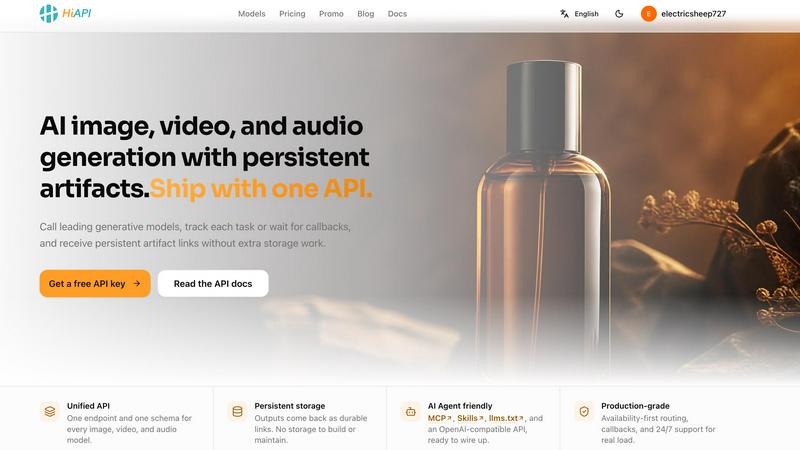
About HiAPI
HiAPI is a developer-first AI API platform designed to unify access to leading generative AI models for image, video, and audio creation. Instead of managing multiple API keys, billing systems, and integration patterns for different model providers, HiAPI offers a single endpoint, one API key, and a consistent request schema that is compatible with OpenAI's existing format. This means developers can call models like GPT Image 2, Seedream 5.0 Pro, FLUX 1.1 Pro, Seedance 2.0, and MiniMax Music 2.6 through the same interface, dramatically reducing integration time and operational overhead.
The platform is built for continuous improvement, allowing teams to iterate on their generative workflows without rebuilding integration layers. Every output from HiAPI comes back as a persistent artifact link, eliminating the need for developers to build and maintain their own storage infrastructure. This persistent storage model is a core differentiator, making it ideal for applications that need reliable, durable access to generated content over time.
HiAPI is designed for both human developers and AI agents. It supports MCP (Model Context Protocol), Skills, and llms.txt, making it ready for agentic workflows in tools like Claude, Cursor, and Codex. The platform also features a unified task API with idempotency keys, callbacks for asynchronous workflows, and transparent per-model pricing so teams can estimate costs before shipping to production. With availability-first routing and 24/7 support, HiAPI is built to handle production-grade loads while maintaining simplicity for rapid prototyping and iteration.
Features of HiAPI
Unified API with OpenAI-Compatible Requests
HiAPI provides a single endpoint and a consistent request schema for every image, video, and audio model. Developers can use the same POST /v1/tasks endpoint, the same authentication pattern, and the same parameter structure regardless of which underlying model they call. This OpenAI-compatible format means existing integrations can switch to HiAPI with minimal code changes, enabling teams to continuously improve their generative capabilities by swapping models without rewriting their API calls. The platform validates model-specific parameters per request, ensuring errors are caught early in the development cycle.
Persistent Artifact Storage
Every output generated through HiAPI is returned as a durable, persistent link. This eliminates the need for developers to build, manage, or pay for separate storage solutions. Simply set the "storage" parameter to "persistent" in your request, and HiAPI handles the rest. This feature is particularly valuable for iterative workflows where generated content needs to be referenced, shared, or reused over time. The persistent storage model allows teams to focus on improving their application logic rather than maintaining infrastructure for file management.
AI Agent Ready with MCP, Skills, and llms.txt
HiAPI is built from the ground up to be consumed by both human developers and autonomous AI agents. The platform supports MCP (Model Context Protocol) for agent-accessible tools, Skills for reusable agent instructions, and llms.txt for immediate discovery and integration. This means agents like Claude, Cursor, and Codex can automatically understand HiAPI's models and APIs, then choose the best integration path. For teams building agentic applications, this reduces the iteration cycle from days to minutes, enabling continuous improvement of agent behaviors without manual reconfiguration.
Production-Grade Task Lifecycle with Callbacks
HiAPI implements a complete asynchronous task lifecycle that supports submission, status checking, and completion callbacks. Each task request can include an idempotency key to prevent duplicate submissions, a callback URL for automatic notification when processing completes, and route selection for different model versions. This architecture is designed for availability-first routing, meaning if a model endpoint is under load, HiAPI can route requests to alternative paths. The callback system eliminates the need for polling, allowing teams to build event-driven workflows that scale efficiently.
Use Cases of HiAPI
Dynamic Content Generation for Marketing Teams
Marketing teams can use HiAPI to generate images, videos, and audio assets at scale for campaigns, social media, and advertising. With a single API, they can call GPT Image 2 for sharp text rendering in promotional graphics, Seedream 5.0 Pro for high-fidelity product images, and MiniMax Music 2.6 for background scores. The persistent storage feature ensures all generated assets are immediately accessible via durable links, enabling iterative A/B testing and rapid content refreshes without manual file management.
AI Agent Integration for Automated Workflows
Developers building AI agents can wire HiAPI directly into their agentic workflows using MCP, Skills, or llms.txt. For example, an agent could generate a product image, create a promotional video with Seedance 2.0, and compose background music, all within a single conversation thread. The agent can track each task's status via callbacks and retrieve persistent artifact links for downstream processing. This enables continuous improvement of automated workflows as new models are added to the platform.
Rapid Prototyping for Creative Applications
Product teams prototyping creative applications can use HiAPI's unified API to experiment with multiple generative models without committing to a single provider. They can test GPT Image 2 for text-heavy designs, FLUX 1.1 Pro for high-detail visuals, and Seedream 5.0 Pro for editing workflows, all through the same codebase. The transparent pricing model allows teams to estimate costs during prototyping, making it easier to iterate on features and optimize for both quality and budget before shipping to production.
Enterprise-Grade Content Production Pipelines
Enterprises building content production pipelines can leverage HiAPI's production-grade infrastructure for consistent, reliable generation at scale. The idempotency keys prevent duplicate processing in retry scenarios, callbacks enable integration with existing workflow systems, and persistent storage ensures audit trails for generated content. Teams can continuously improve their pipelines by adding new models or adjusting parameters without rewriting integration layers, reducing maintenance overhead and accelerating time to market.
Frequently Asked Questions
How do I get started with HiAPI?
Getting started is straightforward. Sign up on the HiAPI website to receive a free API key and up to $1 in free credits. You can then call any supported model through the unified POST /v1/tasks endpoint using standard HTTP requests with your API key in the Authorization header. The API is compatible with OpenAI's request format, so if you have existing code for OpenAI image generation, you can adapt it with minimal changes. For a quick start, refer to the API docs which include curl, JavaScript, and Python examples.
What models does HiAPI currently support?
HiAPI supports a curated set of leading generative AI models across image, video, and audio domains. Image models include GPT Image 2 for text rendering, Seedream 5.0 Pro for flagship generation and editing, FLUX 1.1 Pro for high-fidelity images, and Nano Banana 2 for fast generation with character consistency. Video models include Seedance 2.0 for cinematic video with native audio. Audio models include MiniMax Music 2.6 for turning prompts and lyrics into complete songs. The platform continuously adds new models, so check the model details page for the latest offerings and parameters.
How does persistent artifact storage work?
When you submit a generation task with the "storage" parameter set to "persistent", HiAPI stores the output and returns a durable link that you can use to access the artifact indefinitely. You do not need to build or maintain any storage infrastructure. This is especially useful for applications that need to reference generated content over time, such as in marketing campaigns, content libraries, or agent workflows. The persistent links are low-cost and designed for production use, allowing you to focus on improving your application rather than managing files.
Can I use HiAPI with AI agents like Claude or Cursor?
Yes, HiAPI is designed specifically for AI agent integration. It supports MCP (Model Context Protocol) for agent-accessible tools, Skills for reusable agent instructions, and llms.txt for automatic discovery. You can paste the llms.txt prompt into your agent so it understands HiAPI's models and APIs, then the agent can choose between Skills, Remote MCP, or direct API integration as the best setup path. This makes HiAPI ready for use in Claude, Cursor, Codex, and other agent platforms.
Pricing of HiAPI
HiAPI operates on a transparent pay-as-you-go pricing model. Every model lists its price upfront on the model details page, allowing you to estimate costs before integrating. New users receive up to $1 in free credits upon signup. There are no monthly commitments or tiered plans; you only pay for the API calls you make. This pricing structure enables continuous improvement by allowing teams to experiment with different models and workflows without financial risk, then scale usage predictably as their applications grow.
Similar to HiAPI

ImageGPT is an all-in-one AI creative platform for generating, editing and transforming images and videos using AI.

Create release-ready album covers from a prompt or photo. Generate, refine, and export art for singles, EPs, mixtapes, and playlists.

A free browser-based toolkit for creating, cutting, converting, and previewing sprite sheet animations.

Z Image Turbo is an online AI image generator for photorealistic images, bilingual posters, ecommerce visuals, ads, and social content.


Enhance photos, create images, and generate videos with AI workflows, effects, and production-tested models.

AI image and video studio. Generate from a prompt, animate stills, swap faces, restyle clips and edit — one credit pool, no subscription.

NanoEditor is an AI-powered D&D portrait generator that turns character details like ancestry, class and gear into focused fantasy RPG art.