
Dreamflow vs Miget
Side-by-side comparison to help you choose the right product.
Dreamflow
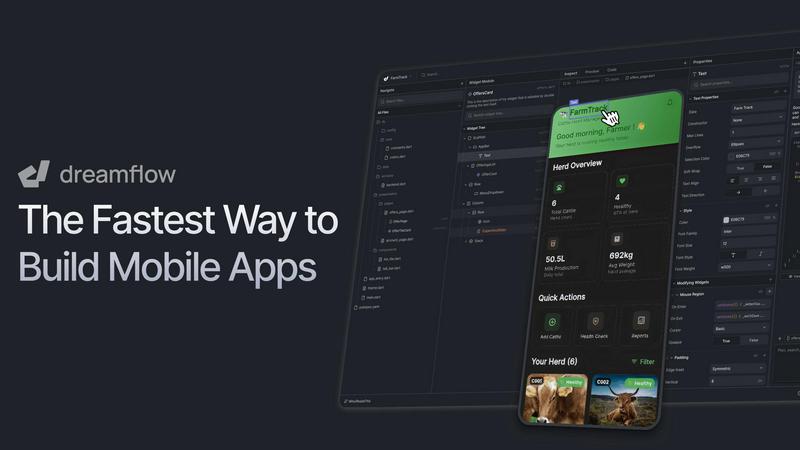
Dreamflow seamlessly turns your AI prompts into real, deployable apps through an iterative visual and code canvas.
Last updated: March 1, 2026

Miget
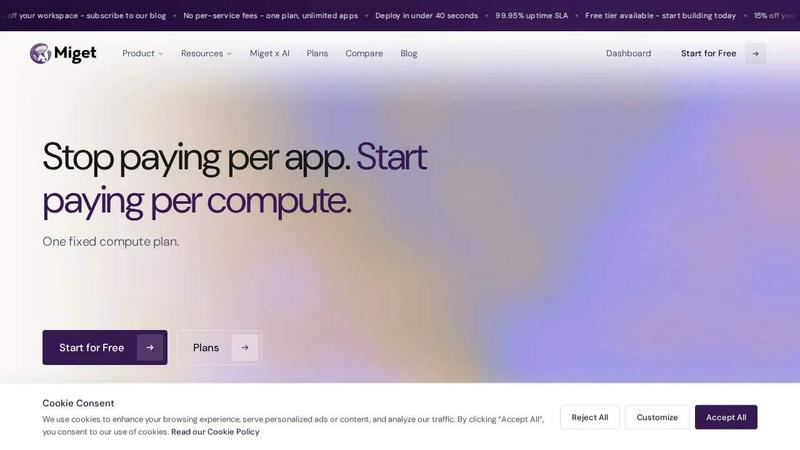
Miget empowers you to deploy unlimited apps and services on a single flat-rate plan, eliminating per-service fees for seamless scaling.
Last updated: April 13, 2026
Visual Comparison
Dreamflow
Miget
Feature Comparison
Dreamflow
Tri-Surface Editing
Dreamflow's revolutionary workflow synchronizes three distinct but interconnected surfaces: an AI Agent, a Visual Canvas, and full Flutter Code. You can initiate a build with a simple prompt, adjust components visually with drag-and-drop ease, and then seamlessly switch to the underlying code for precise customization. Every modification in one view is instantly reflected in the others, ensuring your project is perpetually in a shippable state and eliminating the friction of traditional, linear development paths.
AI-Powered Development
The platform features a context-aware AI agent that understands app patterns and best practices. It goes beyond simple code generation to intelligently scaffold entire features, suggest improvements, and implement changes based on your natural language prompts. This AI assistance accelerates the initial build and supports continuous refinement, learning from your project to provide increasingly relevant suggestions as you iterate.
Build for Any Screen
Powered by Flutter, Dreamflow enables you to build robust, responsive applications that automatically adapt to every device size. From mobile phones and tablets to web browsers, your app maintains a polished user experience. The platform simplifies deployment, allowing you to publish your app to the Apple App Store, Google Play Store, and the web with just a few clicks from a single codebase.
Integrated Backend & Deployment
Dreamflow integrates backend services like Firebase and Supabase out of the box, allowing you to build full-stack applications with real-time databases, authentication, and storage from day one. Combined with one-click deployment for web and mobile app stores, the platform handles the entire pipeline from initial idea to live, scalable product, removing infrastructure complexity and letting you focus on building and improving your app.
Miget
Unlimited Apps and Services
Miget's pricing model allows for unlimited applications, databases, and background workers within a single fixed compute plan. This eliminates per-service billing surprises, enabling teams to innovate freely without the fear of escalating costs for each service they deploy.
Instant Deployments
With Miget, deploying your services takes less than 40 seconds on average. This quick turnaround allows developers to push changes and updates rapidly, facilitating agile development practices and enhancing team productivity.
Managed Databases
Miget offers managed database services such as PostgreSQL and Redis, all included within your compute budget. This means you can leverage powerful database solutions without worrying about additional fees, streamlining your development process.
GitHub-Native Deploys
Miget seamlessly integrates with GitHub, making deployments as simple as pushing to a branch. This automated process eliminates the need for complex CI/CD configurations, allowing developers to focus on coding while Miget handles the build and deployment processes.
Use Cases
Dreamflow
Rapid Prototyping and MVPs
Entrepreneurs and product managers can use Dreamflow to transform a concept into a functional Minimum Viable Product (MVP) in hours, not weeks. By describing the core idea to the AI and visually refining the UI, teams can quickly create a tangible app to validate market fit, gather user feedback, and iterate based on real-world data before committing extensive resources.
Professional App Development
Professional developers and agencies can leverage Dreamflow to accelerate client projects and internal tools. The platform streamlines the initial scaffolding and UI development, allowing developers to focus their expertise on complex business logic, custom animations, and performance optimization within the clean, exported Flutter code, significantly reducing time-to-market.
Cross-Platform App Creation
Startups and businesses aiming to reach users on iOS, Android, and the web can use Dreamflow to build once and deploy everywhere. The Flutter foundation ensures native performance and a consistent interface across all platforms, managed through a single, synchronized project that eliminates the need to maintain separate codebases for each operating system.
Educational Tool for Learning Development
Aspiring developers and students can use Dreamflow as a powerful educational bridge. They can start by visualizing how app components connect, use AI to understand code structure, and then examine and modify the generated Flutter (Dart) code. This cyclical process of seeing the visual result of code changes demystifies app development and provides a practical, hands-on learning environment.
Miget
Startups and Indie Developers
Miget is ideal for startups and indie developers who need to launch applications quickly and affordably. With a single monthly fee covering unlimited services, they can experiment and scale without worrying about costs.
Agile Development Teams
Agile teams benefit from Miget's rapid deployment capabilities and managed services. The ability to create full-stack previews for each pull request allows for thorough testing and collaboration, streamlining the development workflow.
Enterprise Applications
For enterprises, Miget offers the flexibility of deploying multiple applications and services without the complexity of traditional PaaS platforms. The dedicated support and compliance tools ensure that enterprise needs are met efficiently.
Educational Projects
Miget is a perfect fit for educational projects and coding bootcamps, where students can learn and build applications without incurring significant costs. The free tier allows learners to experiment and deploy their projects freely.
Overview
About Dreamflow
Dreamflow is the next evolution in app development, a visual AI builder designed to transform ideas into production-ready mobile applications with unprecedented speed and flexibility. It empowers a diverse spectrum of builders—from solo founders and entrepreneurs to professional developers and enterprise teams—to create real, scalable apps. The core innovation is a seamless, non-linear workflow that breaks free from traditional constraints. Instead of being locked into a single method like prototyping, no-code, or manual coding, Dreamflow synchronizes three powerful surfaces: AI-driven prompting, a visual canvas editor, and full Flutter code. You can start by simply describing your app idea, visually refine the layout and logic, and dive directly into clean, production-ready Dart code for granular control. Every change is instantly reflected across all surfaces, ensuring your work is always in a deployable state. Built by the team behind FlutterFlow and trusted by over 2 million builders, Dreamflow is designed for continuous iteration, allowing you to build, refine, and improve your app in a natural, cyclical flow of creative development without installation lock-in.
About Miget
Miget is a revolutionary Platform as a Service (PaaS) that transforms how developers deploy and manage applications. Unlike traditional PaaS platforms that charge per app, database, or worker, Miget offers a unique pricing model where users pay for fixed compute capacity, enabling them to deploy unlimited applications, databases, and services without incurring additional costs for each component. This approach encourages innovation and experimentation, allowing developers to focus on building their projects rather than worrying about escalating costs. Built on the robust Kubernetes architecture, Miget ensures full isolation between tenants and offers a seamless deployment experience from Git or Docker Registry. It caters to developers of all levels, from indie hackers to large enterprises, providing managed services such as PostgreSQL and Redis, custom domains, and automatic TLS for enhanced security. With Miget, you can deploy your projects in under 40 seconds and enjoy a 99.95% uptime SLA, making it a reliable choice for any production environment.
Frequently Asked Questions
Dreamflow FAQ
How does Dreamflow handle code quality and customization?
Dreamflow generates clean, production-ready Flutter (Dart) code that follows best practices. The code is fully accessible and customizable. You can dive into the code editor at any point to make granular changes, add custom functions, or integrate third-party packages. Any code you write manually is synchronized back to the visual canvas, maintaining the seamless connection between all surfaces.
Can I export my app and own the code?
Yes. On the Hobby plan and above, Dreamflow provides full code export. You can download the complete Flutter project, own the source code outright, and continue development in your preferred IDE (like VS Code or Android Studio). This ensures there is no vendor lock-in, and you have complete freedom to host, modify, and scale your application independently.
What backend services does Dreamflow support?
Dreamflow offers managed backend integrations with Firebase and Supabase out of the box. These services handle essential infrastructure like authentication, real-time databases, cloud storage, and serverless functions. The platform provides a visual interface to set up and connect these services, allowing you to build full-stack applications without managing server infrastructure.
Is Dreamflow suitable for building complex, large-scale applications?
Absolutely. Dreamflow is designed for continuous iteration and scales from simple prototypes to complex, enterprise-grade applications. Features like version control (Git) on the Pro plan, clean code architecture, and the ability to integrate custom code and packages make it robust enough for professional, large-scale development workflows used by teams.
Miget FAQ
What makes Miget different from traditional PaaS?
Miget's unique pricing model allows users to pay for compute capacity rather than individual services, enabling unlimited applications and databases without extra costs. This fosters innovation without the burden of escalating expenses.
How fast can I deploy my applications?
Miget boasts an average deployment time of under 40 seconds. This rapid deployment capability allows developers to quickly iterate on their applications, enhancing productivity and responsiveness to changes.
Is there a free tier available?
Yes, Miget offers a free tier that allows users to start building and deploying applications without any initial investment. This is perfect for individuals and teams looking to experiment and learn.
What kind of support does Miget offer?
Miget provides 24/7 support to ensure that users can receive assistance whenever they need it. This is particularly valuable for teams operating in production environments where uptime is critical.
Alternatives
Dreamflow Alternatives
Dreamflow is a visual AI builder for production-ready mobile applications, representing a new category of development tools that unify AI prompting, visual design, and clean code generation. It's designed for a cyclical, iterative workflow where changes sync seamlessly across all editing surfaces. Builders often explore alternatives for various reasons, such as specific budget constraints, a need for different platform support like web or desktop, a preference for a purely code-centric environment, or a requirement for particular third-party integrations not yet available. The search for the right tool is a natural part of the development journey. When evaluating other platforms, consider your core needs: the required output platform (iOS, Android, web), the desired balance between visual speed and code control, the importance of true production-ready code generation, and how the tool supports your team's continuous improvement cycle from idea to deployment and beyond.
Miget Alternatives
Miget is a pioneering platform as a service (PaaS) that enables users to deploy an unlimited number of applications, databases, and background workers under a single, flat-rate plan. This innovative approach addresses the common pain points of traditional PaaS offerings, where users are often charged separately for each component, leading to unpredictable costs. Users frequently seek alternatives to Miget for various reasons, including pricing structures, specific feature requirements, or compatibility with their existing workflows and platforms. When evaluating alternatives, it’s essential to consider factors such as pricing transparency, ease of use, scalability, and the quality of customer support, ensuring the chosen solution aligns with both current needs and future growth.