
Agenta vs CloudBurn
Side-by-side comparison to help you choose the right product.

Agenta is the open-source LLMOps platform that centralizes prompt management and evaluation for reliable AI apps.
Last updated: March 1, 2026

CloudBurn
CloudBurn shows AWS cost estimates in pull requests to prevent costly mistakes before deployment.
Last updated: February 28, 2026
Visual Comparison
Agenta
CloudBurn
Feature Comparison
Agenta
Unified Playground & Experimentation
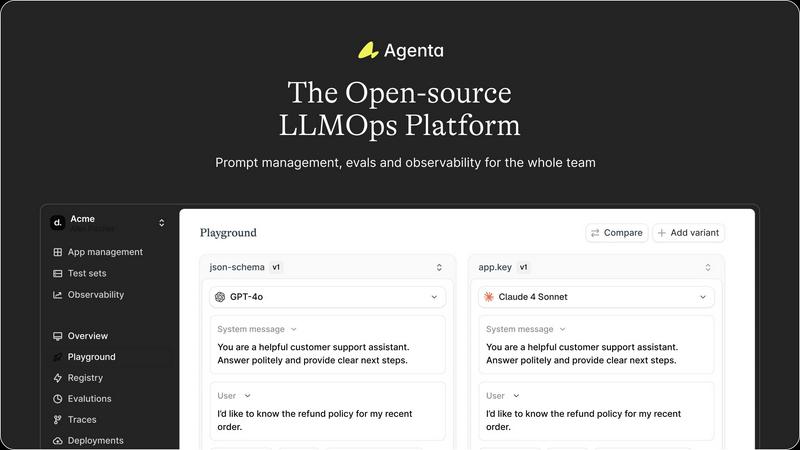
Agenta provides a centralized playground where teams can experiment with different prompts, parameters, and foundation models from various providers side-by-side in a single interface. This model-agnostic approach prevents vendor lock-in and allows for direct comparison. Every change is automatically versioned, creating a complete history of experiments so teams can track what worked, what didn't, and iterate efficiently based on real data, turning experimentation into a structured process.
Systematic Evaluation Framework
Replace guesswork with evidence using Agenta's comprehensive evaluation system. Teams can create automated test suites using LLM-as-a-judge, custom code, or built-in evaluators. Crucially, you can evaluate the full trace of an agent's reasoning, not just the final output, to pinpoint failure points. The platform also integrates human evaluation, allowing domain experts to provide feedback directly within the workflow, closing the loop between automated and human judgment.
Production Observability & Debugging
Gain full visibility into your live AI applications with detailed tracing of every LLM request. When issues arise, teams can quickly drill down to find the exact source of errors. Traces can be annotated collaboratively and, with a single click, turned into permanent test cases for future experiments. This capability, combined with live performance monitoring and online evaluations, enables proactive detection of regressions and continuous refinement of production systems.
Collaborative Workflow Hub
Agenta breaks down silos by providing tools for every team member. Domain experts can safely edit and test prompts through a dedicated UI without writing code. Product managers can run evaluations and compare results visually. This seamless collaboration between technical and non-technical roles, supported by full parity between the UI and API, ensures everyone contributes to the iterative cycle of improvement, aligning the entire team on a single, reliable development process.
CloudBurn
Automated Pull Request Cost Analysis
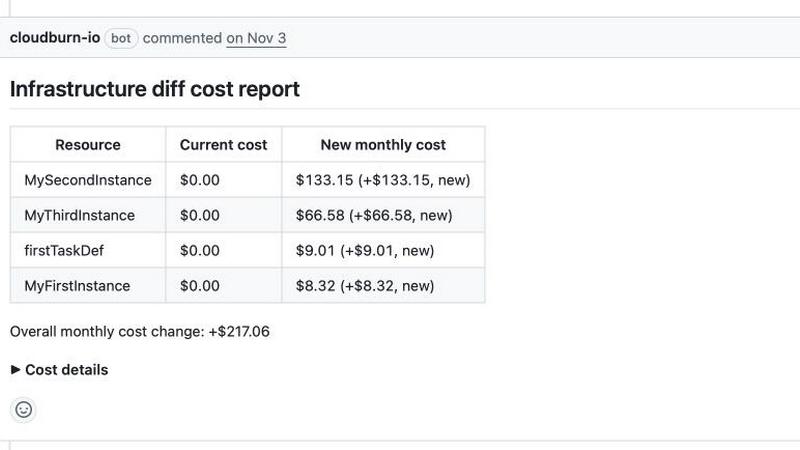
CloudBurn automatically analyzes the infrastructure diff from your Terraform plan or AWS CDK synthesis output directly within your GitHub pull requests. It calculates the precise monthly cost impact of the proposed changes and posts a detailed, line-item report as a comment. This creates a seamless, non-disruptive feedback loop where cost awareness becomes a natural part of the code review process, just like checking for bugs or security issues.
Real-Time AWS Pricing Data
The tool leverages always up-to-date AWS pricing information to generate accurate cost estimates. It accounts for various factors like instance types, regions, storage volumes, and managed services (e.g., Fargate). This eliminates the need for manual, error-prone spreadsheet calculations and ensures your team is making decisions based on the latest pricing, preventing surprises from outdated rate cards or estimations.
Seamless GitHub Integration & Security
CloudBurn is installed directly from the GitHub Marketplace and integrates 100% through your GitHub account. Billing, setup, and repository permissions are handled securely via GitHub, requiring no separate credentials or complex AWS IAM role configurations for the tool itself. This simplifies adoption and maintains your existing security posture while providing immediate value.
Detailed Cost Breakdown & Visibility
Beyond a simple total, CloudBurn provides a granular breakdown of costs per resource. The report shows current versus new costs, highlights net changes, and details the hourly rate, usage type, and service description for each component. This deep visibility helps developers understand exactly which resources are driving cost increases and facilitates informed discussions about architectural trade-offs during reviews.
Use Cases
Agenta
Streamlining Enterprise Chatbot Development
Teams building customer support or internal knowledge base chatbots use Agenta to manage hundreds of prompt variations for different intents. Product managers and subject matter experts collaborate in the playground to refine responses, while automated evaluations on real user queries ensure each new prompt version improves accuracy and tone before being safely deployed to production, significantly reducing rollout risk.
Building and Tuning Complex AI Agents
For developers creating multi-step AI agents with frameworks like LangChain or LlamaIndex, Agenta is indispensable for debugging. The full-trace evaluation allows engineers to see exactly which step in an agent's reasoning chain failed. They can save problematic traces as tests, iterate on the prompt or logic for that specific step, and validate the fix within a unified platform, dramatically speeding up development cycles.
Managing LLM Application Quality Assurance
QA teams and ML engineers establish a rigorous, continuous testing regime using Agenta. They build a growing dataset of edge cases and failure modes from production traces. Automated evaluation suites run against this dataset with every code or prompt change, providing quantitative evidence of performance impact. This systematic approach replaces sporadic "vibe checks" with data-driven gating for production releases.
Facilitating Cross-Functional AI Innovation
When a new LLM-powered feature is prototyped, Agenta enables safe exploration. Domain experts can experiment with prompt wording to capture nuanced requirements, while developers integrate new models and APIs. The entire team can view evaluation results, annotate outputs, and collectively decide on the best path forward, ensuring the final product is robust and aligns with both technical and business goals.
CloudBurn
Preventing Costly Misconfigurations in PRs
Development teams can use CloudBurn to catch accidental deployments of over-provisioned resources, such as mistakenly selecting a t3.xlarge instance instead of a t3.micro. By seeing a +$133.15 monthly cost alert directly on the pull request, the team can immediately correct the configuration before it ever reaches production, turning a potential multi-thousand dollar mistake into a minor, free correction.
Enabling Developer-Led FinOps & Cost Culture
CloudBurn empowers developers to own cost optimization by giving them the data they need at the right time. Instead of a central FinOps team policing bills after the fact, developers can proactively design cost-efficient architectures. This shifts cost management left in the CI/CD pipeline, building a continuous improvement mindset where cost is a first-class consideration alongside performance and scalability.
Streamlining Infrastructure Code Reviews
For platform and DevOps engineers reviewing Terraform or CDK pull requests, CloudBurn provides critical financial context. Reviewers can assess not just the technical correctness and security of the code, but also its economic efficiency. This leads to more holistic reviews and better collaboration between development and operations on achieving both technical and business objectives.
Budget Forecasting for Project Planning
Teams can use the pull request estimates to forecast the monthly cost impact of new features or services as they are being built. By aggregating the cost changes from multiple related PRs, project leads and managers can get a real-time view of the projected cloud spend for an initiative, allowing for better budget planning and resource allocation before final deployment.
Overview
About Agenta
Agenta is the open-source LLMOps platform engineered to transform how AI teams build, evaluate, and deploy reliable large language model applications. It directly addresses the core challenges of unpredictability and disjointed workflows that plague modern AI development. By serving as a single source of truth, Agenta brings developers, product managers, and domain experts together into a unified, collaborative environment. The platform's primary value lies in its integrated suite for prompt management, systematic evaluation, and production observability, enabling a cyclical and iterative development process. This continuous feedback loop allows teams to move away from scattered prompts in Slack and guesswork debugging toward structured, evidence-based iteration. Agenta is built for any team seeking to implement LLMOps best practices, reduce silos, and ship robust AI products with confidence and speed, fostering a culture of continuous improvement at every stage of the LLM application lifecycle.
About CloudBurn
CloudBurn is a proactive cloud cost management platform engineered for modern development teams using Infrastructure-as-Code (IaC) tools like Terraform and AWS CDK. It directly tackles the pervasive and painful issue of unpredictable and spiraling AWS bills. The core problem it solves is the lack of cost visibility during the development lifecycle; teams often discover the financial impact of their infrastructure changes only weeks later on their monthly invoice, when remediation is costly and complex. CloudBurn embeds financial intelligence directly into the existing code review workflow by providing real-time, automated cost estimates for every pull request. This empowers developers, platform engineers, and FinOps practitioners to make cost-aware decisions before code merges and deploys to production. Its main value proposition is fostering a continuous culture of financial responsibility, enabling teams to optimize cloud spend from the very first line of code, prevent costly misconfigurations, and achieve an immediate return on investment by catching expensive mistakes early in the development cycle.
Frequently Asked Questions
Agenta FAQ
Is Agenta really open-source?
Yes, Agenta is a fully open-source platform. You can view the source code on GitHub, self-host the platform on your own infrastructure, and contribute to its development. This ensures transparency, avoids vendor lock-in, and allows for customization to fit specific enterprise needs and security requirements.
How does Agenta handle data privacy and security?
As an open-source platform, Agenta can be deployed within your private cloud or on-premise environment, ensuring your prompt data, evaluation results, and production traces never leave your network. This gives you full control over data governance and compliance, which is critical for teams working with sensitive or proprietary information.
Can Agenta integrate with our existing tech stack?
Absolutely. Agenta is designed to be framework-agnostic. It seamlessly integrates with popular LLM frameworks like LangChain and LlamaIndex, and can work with models from any provider, including OpenAI, Anthropic, Azure, and open-source models. It connects via API, fitting into your existing CI/CD and MLOps pipelines.
What is the difference between Agenta and just using a notebook or spreadsheet?
While notebooks and spreadsheets are useful for initial exploration, they become chaotic and unscalable in team settings. Agenta provides version control, a centralized system of record, structured evaluation workflows, and production observability tools that spreadsheets lack. It transforms ad-hoc, individual experimentation into a collaborative, reproducible, and continuous engineering process.
CloudBurn FAQ
How does CloudBurn calculate the cost estimates?
CloudBurn analyzes the output of your terraform plan or cdk diff command, which details the proposed infrastructure changes. It then cross-references the resource types, configurations, and regions specified in this diff with real-time AWS pricing data. The calculation assumes 730 hours of usage per month (24/7 operation) to provide a standardized monthly projection, with a detailed breakdown of the hourly rates and components for full transparency.
What infrastructure-as-code tools does CloudBurn support?
CloudBurn currently provides native integration and dedicated GitHub Actions for two major IaC frameworks: HashiCorp Terraform and AWS Cloud Development Kit (CDK). The platform is designed to parse the specific diff/output format from these tools to generate accurate cost reports. Support for additional tools may be explored as part of the product's continuous development roadmap.
Is my code or cloud credentials secure with CloudBurn?
Yes. CloudBurn operates on a secure, principle-of-least-access model. The tool is installed via GitHub and only receives the textual output of your terraform plan or cdk diff from your GitHub Actions workflow. It does not require or have access to your AWS credentials, secret keys, or the actual state of your live infrastructure. Your code and cloud environment remain fully under your control.
What is the difference between the Community and Pro plans?
The Community plan is free forever and provides core cost estimation functionality on pull requests. The Pro plan, which includes a 14-day free trial, offers advanced features such as cost history tracking, trend analysis, team reporting dashboards, and integration with Slack or Microsoft Teams for notifications. This enables deeper financial oversight and continuous improvement tracking for growing teams.
Alternatives
Agenta Alternatives
Agenta is an open-source LLMOps platform designed for teams building applications with large language models. It centralizes the development workflow, focusing on prompt management, evaluation, and collaboration to create more reliable AI systems. This category of tools is essential for moving from experimental prototypes to stable, production-ready applications. Teams explore alternatives for various reasons, including specific feature requirements, budget constraints, integration needs with existing tech stacks, or preferences for different deployment models like fully managed services versus self-hosted solutions. The ideal platform must align with a team's technical maturity and operational scale. When evaluating options, consider core capabilities like systematic testing, version control for prompts, and robust observability. The goal is to find a solution that supports a cyclical, iterative development process, enabling continuous refinement and evidence-based improvements to your LLM applications.
CloudBurn Alternatives
CloudBurn is a development tool focused on FinOps and cloud cost management. It integrates directly into the pull request workflow for Terraform and AWS CDK, providing automatic AWS cost estimates to prevent budget overruns before code is merged. This proactive approach helps teams foster a culture of continuous cost optimization from the very first line of infrastructure code. Users may explore alternatives for various reasons, such as needing support for additional cloud providers beyond AWS, requiring different integration points within their CI/CD pipeline, or seeking a solution that aligns with specific budget constraints or feature priorities. The landscape of cloud cost management tools is diverse, catering to different stages of the development lifecycle. When evaluating an alternative, consider how it embeds cost awareness into your existing workflows. The goal is to find a solution that provides accurate, real-time insights without creating friction, enabling your team to make iterative improvements. Look for tools that offer the granularity, integration depth, and pricing model that support your team's journey toward sustainable cloud financial management.