
Interactive Circle of Fifths vs Polym
Side-by-side comparison to help you choose the right product.

Interactive Circle of Fifths
Master music theory effortlessly with our evolving interactive circle of fifths that enhances your practice experience.
Last updated: March 1, 2026

Polym is an audio app that uses cognitive science to help you remember what you learn.
Last updated: March 1, 2026
Visual Comparison
Interactive Circle of Fifths
Polym
Feature Comparison
Interactive Circle of Fifths
Dynamic Visualizers
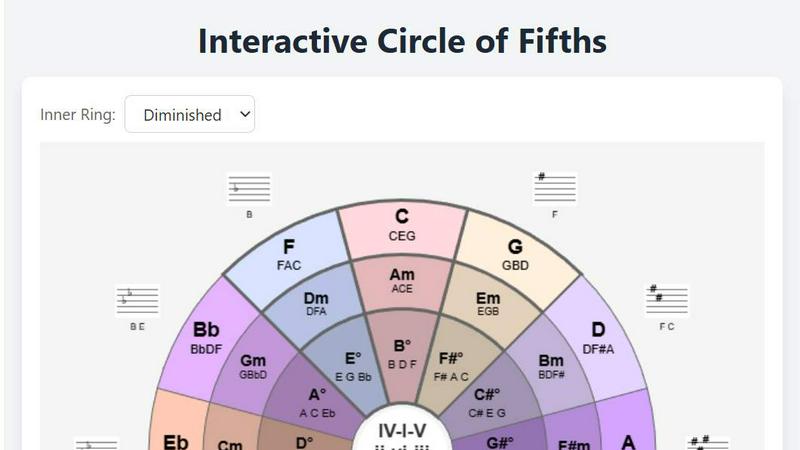
The Interactive Circle of Fifths features dynamic visualizers for both piano and guitar, allowing users to see how chords and scales relate in real-time. This visual feedback is crucial for bridging the gap between theoretical concepts and practical application, making it an essential tool for effective learning.
Chord Sequencer
With the built-in chord sequencer, users can experiment with various chord progressions. This feature allows musicians to see how different chords function together, facilitating a deeper understanding of harmonization and composition.
Scales Exploration
The platform offers a comprehensive exploration of scales, including the pentatonic, blues, and diatonic scales. Users can layer these scales into their practice, progressively building complexity and enhancing their musical vocabulary over time.
Interactive Learning Experience
The Interactive Circle of Fifths emphasizes an iterative learning experience, encouraging users to continuously engage with the tool. By cycling through different chords and scales, users can refine their skills and deepen their understanding of music theory in an enjoyable and engaging manner.
Polym
Medium-Form Audio Courses
Polym offers in-depth yet concise audio courses on foundational subjects, carefully selected for their broad relevance. These are not simple audiobooks; they are structured educational experiences designed for audio consumption. The content focuses on core concepts and abstract principles, ensuring you build a strong, applicable knowledge base without getting lost in dense textual details, making your learning journey efficient and continuously building.
Active Learning with Retrieval Practice
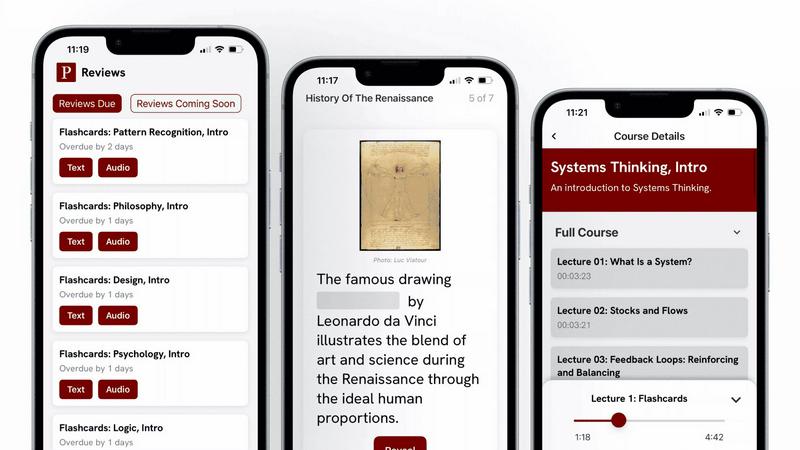
Moving beyond passive listening, Polym integrates active learning directly into its core. The app employs retrieval practice through tools like audio flashcards, prompting you to actively recall information. This iterative process of testing yourself strengthens neural pathways, solidifying memory and transforming fleeting information into deeply ingrained knowledge you can reliably access and apply.
Spaced Repetition System
To combat the natural cycle of forgetting, Polym utilizes a spaced repetition algorithm. The app strategically schedules review sessions for previously learned material at optimal intervals. This scientifically-backed approach spaces out your practice over time, which is proven to dramatically improve long-term retention and ensure your foundational knowledge remains sharp and readily available through continuous, intelligent reinforcement.
Interleaved Learning Sessions
Polym enhances understanding by mixing related topics from different courses during study sessions, a technique known as interleaving. Instead of blocking one subject at a time, you'll encounter varied but connected concepts. This method improves your ability to discriminate between ideas and apply them in different contexts, fostering deeper, more flexible thinking and building stronger cognitive connections iteratively.
Use Cases
Interactive Circle of Fifths
Beginner Musicians
For beginners, the Interactive Circle of Fifths serves as a foundational tool to grasp basic music theory concepts. It simplifies complex topics, enabling new learners to confidently explore major and minor chords while hearing their impact.
Composers and Songwriters
Composers and songwriters can leverage the platform to experiment with chord progressions and explore emotional nuances in their music. The chord sequencer allows for rapid iteration, making the creative process more fluid and dynamic.
Music Educators
Music educators can utilize the Interactive Circle of Fifths as a teaching aid in their classrooms. The visual and interactive elements help to demystify music theory, making lessons more engaging and effective for students of varying skill levels.
Practicing Musicians
For practicing musicians, this tool offers a structured approach to skill development. By cycling through scales and chords, users can identify areas for improvement and build their repertoire systematically, making practice sessions more productive.
Polym
Professional Skill Reinforcement
A data analyst can use Polym to continuously reinforce core concepts in statistics and probability during their daily commute. The spaced repetition and audio flashcards ensure key methodologies and principles remain top-of-mind, allowing for sharper, more confident application in work projects through an ongoing cycle of micro-learning and review.
Academic Study Companion
A university student studying philosophy or computer science can use Polym's abbreviated courses and term reviews as a powerful supplement to their textbooks. The active retrieval practice and interleaving of related concepts (like logic and algorithms) help deepen understanding and improve exam recall, turning downtime into productive, iterative study sessions.
Cultivating Polymathic Thinking
An intellectually curious individual seeking to connect ideas across disciplines can explore Polym's diverse curriculum. By engaging with courses in history, economics, and AI, and experiencing interleaved sessions, they systematically build a web of interconnected knowledge, fostering the innovative, big-picture thinking characteristic of a polymath through continuous cross-pollination of ideas.
Foundational Knowledge Maintenance
A professional transitioning into a management or strategic role can use Polym to efficiently refresh and retain essential knowledge in economics and scientific reasoning. The app’s plan ensures regular, manageable engagement with foundational material, preventing skill decay and enabling the continuous application of critical concepts in decision-making.
Overview
About Interactive Circle of Fifths
The Interactive Circle of Fifths is an innovative web-based music theory tool designed to unravel the complexities of musical relationships, including keys, chords, and scales. Unlike traditional, static diagrams, this platform transforms the Circle of Fifths into a dynamic, interactive experience that caters to musicians of all levels. From enthusiastic beginners to experienced composers, users can easily navigate through a continuous cycle of discovery, enhancing their understanding of harmonic concepts. The core value of the Interactive Circle of Fifths lies in its ability to make abstract music theory tangible and auditory. Users can visualize chord progressions, hear their emotional nuances, and grasp their theoretical significance all at once. By integrating visualizers for piano and guitar, the tool effectively bridges the gap between theoretical knowledge and practical application. It encourages a journey of ongoing improvement, allowing users to start with basic major chords and gradually explore related minors, diminished chords, and intricate scales such as pentatonic, blues, and harmonized scales. Ultimately, it serves not just as a reference but as a dedicated practice partner on the path to musical mastery.
About Polym
Polym is a revolutionary audio application engineered for the lifelong learner, designed to fundamentally enhance how foundational knowledge is retained and recalled. It is built on a core principle of continuous cognitive improvement, leveraging proven techniques from cognitive science to transform passive listening into an active, iterative learning process. The app offers a curated library of medium-form audio courses on essential subjects like Statistics, Probability, Logic, Economics, Computer Science, AI, Philosophy, and History. Each course is meticulously crafted for self-study, featuring abbreviated versions and integrated audio flashcards that promote ongoing engagement and review.
Tailored for students, professionals, and perpetually curious minds, Polym's value proposition lies in its unique application of retrieval practice, spaced repetition, and interleaving. This methodology ensures that learning is not a one-time event but a cyclical journey of reinforcement, moving knowledge from short-term memory into durable, long-term understanding. By focusing on the abstract concepts of technical and mathematical fields in an audio-optimized format, Polym empowers users to grasp and apply complex ideas across various contexts, fostering the adaptable mindset of a modern polymath. The app is your partner in a continuous cycle of learning, forgetting, and relearning—each iteration stronger than the last.
Frequently Asked Questions
Interactive Circle of Fifths FAQ
How does the Interactive Circle of Fifths differ from a traditional Circle of Fifths?
The Interactive Circle of Fifths offers a dynamic, web-based environment that allows users to visualize and hear the relationships between chords, keys, and scales, unlike the static representation of traditional diagrams.
Can I use the tool for both guitar and piano?
Yes, the Interactive Circle of Fifths includes visualizers and functionalities for both guitar and piano, making it a versatile tool for musicians who play multiple instruments.
Is the Interactive Circle of Fifths suitable for all skill levels?
Absolutely! The tool is designed for musicians at any level, from beginners just starting to learn music theory to seasoned composers looking to deepen their understanding of harmonic relationships.
How can I incorporate the Interactive Circle of Fifths into my practice routine?
You can use the tool to explore different chord progressions, experiment with scales, and visualize how chords relate to one another, all while iteratively improving your skills and expanding your musical repertoire.
Polym FAQ
What research supports the learning strategies Polym uses?
The strategies of retrieval practice, spaced repetition, and interleaving are extensively validated by cognitive science research. These techniques are shown to significantly enhance long-term memory retention and recall compared to passive study methods like re-reading. You can explore a foundational overview of this research through resources like the National Institutes of Health (e.g., https://www.ncbi.nlm.nih.gov/pmc/articles/PMC9781761/).
What subjects are covered in the Polym library?
Polym's curriculum focuses on foundational knowledge applicable across fields. Current subjects include Logic, Logical Fallacies, Cognitive Biases, Statistics, Probability, Scientific Research, Algorithms, Economics, Philosophy, and History. The library is designed for continuous expansion, iteratively adding new topics to support a well-rounded knowledge base.
Who is the ideal user for Polym?
Polym is designed for anyone committed to lifelong learning and the continuous improvement of their mental models. It is ideal for students, professionals seeking an edge, autodidacts, and curious minds who want to efficiently retain and recall essential concepts that are valuable both in professional settings and in everyday critical thinking and decision-making.
How is technical content adapted for an audio format?
Polym intentionally focuses on the subset of technical and mathematical material that translates effectively to audio, emphasizing abstract concepts, definitions, relationships, and practical applications over complex notation. This approach allows you to grasp the fundamental principles iteratively, strengthening your ability to understand and apply the concepts without needing to visualize dense equations.
Alternatives
Interactive Circle of Fifths Alternatives
The Interactive Circle of Fifths is an innovative web-based tool designed to enhance music theory understanding by providing an interactive experience that allows users to explore the relationships between keys, chords, and scales. This product falls within the Education & Learning category, appealing to musicians of all levels who seek to deepen their knowledge and practical skills in music. Users often look for alternatives to the Interactive Circle of Fifths due to various reasons, such as pricing concerns, specific feature requirements, or compatibility with different platforms and devices. When choosing an alternative, it's important to consider the tool's usability, the comprehensiveness of its features, and how well it supports your individual learning style and musical goals.
Polym Alternatives
Polym is an audio-based learning application in the education and technology category, designed to boost knowledge retention and recall. It focuses on delivering foundational knowledge through active learning techniques like spaced repetition and retrieval practice. Users may explore alternatives for various reasons, such as seeking different pricing models, specific content libraries, or platform compatibility. Some learners might prioritize visual aids, community features, or a different subject matter focus over Polym's audio-centric, foundational approach. When evaluating other options, consider the core learning methodology, the depth and breadth of content available, and how the tool integrates into your daily routine. The goal is to find a solution that not only presents information but, like the best learning systems, reinforces it through continuous, iterative engagement for lasting mastery.