
Hostim.dev vs OpenMark AI
Side-by-side comparison to help you choose the right product.

Hostim.dev
Hostim.dev simplifies Docker app deployment with built-in databases and transparent costs for rapid, secure launches.
Last updated: March 1, 2026

OpenMark AI continuously benchmarks over 100 LLMs on your actual task to find the best model for cost, speed, and quality.
Last updated: March 26, 2026
Visual Comparison
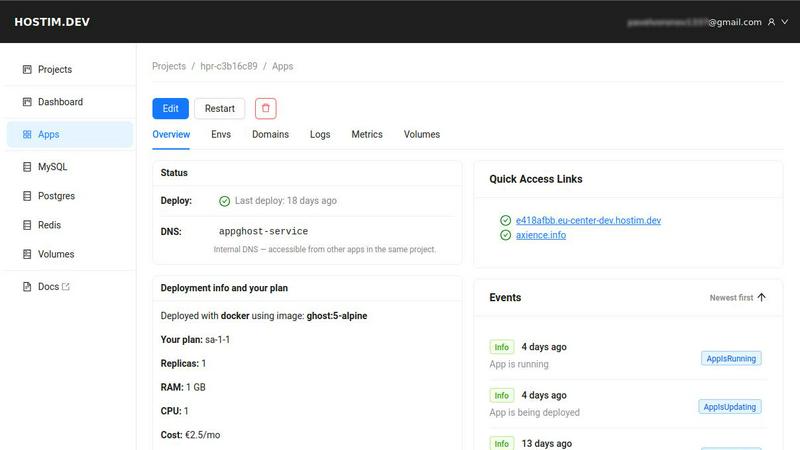
Hostim.dev
OpenMark AI
Feature Comparison
Hostim.dev
Seamless Deployment
Deploying applications is effortless with Hostim.dev. Users can launch their projects quickly using Docker images, Git repositories, or Docker Compose files. This feature allows developers to skip extensive setup procedures, enabling them to go live in just minutes without requiring any DevOps expertise.
Built-in Managed Databases
Hostim.dev offers built-in database solutions, including MySQL, PostgreSQL, and Redis, which are provisioned instantly. This feature eliminates the need for separate database management, allowing users to focus on their applications while the platform handles all database-related tasks automatically.
Project Isolation and Security
Each project on Hostim.dev operates within its own isolated Kubernetes namespace. This unique feature enhances security and compliance with GDPR regulations, as it ensures that data is kept separate and secure. Users can deploy their applications with confidence, knowing that their environments are fully isolated from one another.
Transparent Pricing Model
Hostim.dev features a simple and transparent pricing model that starts at just €2.50 per month. This clear cost structure allows freelancers, startups, and agencies to quote exact prices to clients without worrying about hidden fees or unexpected expenses. Users can easily track costs on a per-project basis, making budgeting straightforward.
OpenMark AI
Plain Language Task Description
Describe the exact task you need an AI to perform using simple, natural language—no complex coding or prompt engineering required. The platform allows you to configure everything from simple instructions to advanced, multi-step workflows, making sophisticated benchmarking accessible to developers and product managers alike. This intuitive setup ensures you're testing what you actually intend to build.
Multi-Model Comparison in One Session
Run your defined task against a wide selection of models from various providers simultaneously. This side-by-side testing environment provides immediate, comparable results, allowing you to see how different models stack up against each other on your specific criteria without the hassle of managing multiple API consoles or scripts.
Real Performance & Cost Metrics
Get results based on actual API calls, not cached or theoretical numbers. OpenMark AI measures and displays critical metrics including latency (response time), the actual cost per request from the provider, and a scored assessment of output quality. This gives you a true picture of what to expect in production, focusing on real cost efficiency.
Stability and Variance Analysis
Understand model consistency by seeing how outputs change across repeat runs of the same task. The platform highlights variance, showing you whether a model is reliably good or just occasionally lucky. This focus on stability is crucial for building trustworthy, predictable AI features that perform the same way every time for your users.
Use Cases
Hostim.dev
Freelancers
Freelancers can leverage Hostim.dev to rapidly deploy applications for their clients without the hassle of managing servers or complex infrastructure. The platform's per-project billing allows for clean handovers, ensuring clients receive exactly what they need without additional overhead.
Agencies
For agencies managing multiple clients, Hostim.dev provides a solution to isolate client projects effectively. Each project can be hosted separately, allowing agencies to control costs and deliver tailored solutions while maintaining a clear cost breakdown for each client.
Students
Students looking to gain real-world experience in application deployment can utilize Hostim.dev to learn on actual infrastructure. With a free trial available, students can experiment with Docker and databases, creating projects that they can proudly showcase in their portfolios.
SaaS Projects
Startups developing Software as a Service (SaaS) applications can benefit significantly from Hostim.dev’s rapid deployment capabilities. The platform's built-in managed databases and storage simplify the development process, allowing teams to focus on building features rather than managing infrastructure.
OpenMark AI
Validating Model Choice for a New Feature
Before committing a model to a new AI-powered feature, use OpenMark AI to test candidate models on a prototype of your exact task. Compare their quality, speed, and cost on real prompts to make a data-driven selection that balances performance with budget, ensuring a strong foundation for your product launch.
Cost Optimization for Existing Workflows
If you're already using an LLM in production, benchmark alternative models to find potential savings. You might discover a less expensive model that delivers comparable quality for your specific use case, or a slightly more expensive one that drastically improves output, allowing for continuous refinement of your operational efficiency.
Ensuring Output Consistency for Critical Tasks
For applications where reliability is non-negotiable—such as data extraction, classification, or automated customer responses—test models across multiple runs to audit their stability. Identify and avoid models with high variance, selecting one that produces consistent, high-quality outputs every time to maintain user trust.
Prototyping and Research for AI Agents
When designing complex systems like AI agents or RAG (Retrieval-Augmented Generation) pipelines, test different LLMs for sub-tasks like routing, summarization, or reasoning. Quickly iterate on your design by benchmarking how various models handle these components, accelerating your research and development cycle with empirical data.
Overview
About Hostim.dev
Hostim.dev is a cutting-edge bare-metal Platform-as-a-Service (PaaS) tailored for developers who desire a straightforward and efficient way to deploy containerized applications. This platform simplifies the deployment process by allowing users to seamlessly launch applications from Docker images, Git repositories, or Docker Compose files. The primary value proposition of Hostim.dev lies in its ability to eliminate the complexities associated with DevOps, enabling developers to focus on building their applications rather than managing infrastructure. With features like automatic provisioning of essential services including MySQL, PostgreSQL, and Redis, along with built-in HTTPS, Hostim.dev ensures that users can get their projects up and running in mere minutes. All hosting occurs within Germany, providing GDPR compliance and enhanced data security. The platform is ideal for freelancers, startups, agencies, and SaaS projects that seek simplicity, transparency, and complete control over their infrastructure, all while enjoying a clear and predictable billing structure.
About OpenMark AI
OpenMark AI is a powerful web application designed to end the guesswork in selecting large language models (LLMs) for production applications. It provides a comprehensive, task-level benchmarking platform where developers and product teams can describe their specific use case in plain language and run the same prompts against a vast catalog of over 100 models in a single, unified session. The core value proposition is delivering actionable, real-world data for pre-deployment decisions. Instead of relying on marketing claims or single, lucky outputs, OpenMark AI shows you performance variance, scored quality, real API latency, and actual cost per request across repeat runs. This cyclical, iterative approach to testing ensures you can continuously improve your model selection based on hard evidence, not hunches. Built for efficiency, it uses a hosted credit system, eliminating the need to manage and configure separate API keys for every provider like OpenAI, Anthropic, or Google. The platform is designed for those who prioritize cost efficiency—finding the optimal balance of quality relative to price—and need confidence that a model will deliver consistent, stable results every time it's called in a live feature.
Frequently Asked Questions
Hostim.dev FAQ
What does the free tier include?
The free tier of Hostim.dev includes a 5-day trial with no signup required. Users can explore the platform's features and deploy applications without entering credit card information, giving them a risk-free opportunity to evaluate the service.
Can I deploy with just a Compose file?
Absolutely. Hostim.dev allows users to deploy applications using just a Docker Compose file. This feature simplifies the deployment process, enabling developers to paste their Compose configuration and go live with minimal effort.
Where is my app hosted?
All applications hosted on Hostim.dev are located on bare-metal servers in Germany. This ensures compliance with GDPR regulations and provides users with peace of mind regarding data privacy and security.
Do I need to know Kubernetes?
No, you do not need to know Kubernetes to use Hostim.dev. The platform abstracts the complexities of Kubernetes management, allowing developers to deploy their applications without requiring extensive DevOps knowledge or experience.
OpenMark AI FAQ
How does OpenMark AI calculate costs?
Costs are calculated based on the actual pricing from each model provider (like OpenAI, Anthropic, etc.) for the tokens consumed by your prompts and the generated completions during the benchmark. OpenMark AI uses real API calls and passes the precise, per-request cost to you, so you see the true expense, not an estimate.
Do I need my own API keys to use OpenMark AI?
No, you do not need to provide or configure any external API keys. OpenMark AI operates on a credit-based system. You purchase credits through the platform, and it manages all the API calls to the various model providers on your behalf, simplifying setup and comparison.
What kind of tasks can I benchmark?
You can benchmark virtually any text-based task, including but not limited to classification, translation, data extraction, question answering, content generation, summarization, code writing, and simulating complex workflows like those used in AI agents or RAG systems. Describe your task in the editor to get started.
How does the platform measure output quality?
Quality is scored through a combination of automated evaluation metrics tailored to your task type and, where applicable, can incorporate your own defined criteria for success. The system analyzes factors like correctness, completeness, and adherence to instruction across all model outputs to provide a comparative quality score.
Alternatives
Hostim.dev Alternatives
Hostim.dev is a cutting-edge bare-metal Platform-as-a-Service (PaaS) tailored for developers who need an efficient way to deploy containerized applications. With its focus on minimizing DevOps complexities, Hostim.dev allows users to launch projects swiftly through Docker images, Git repositories, or Docker Compose files. This streamlined process is particularly appealing to freelancers, startups, and agencies seeking a reliable and secure hosting solution in Germany. Users often seek alternatives to Hostim.dev due to various reasons, including pricing structures, specific feature sets, or unique platform requirements. When evaluating alternatives, it’s essential to consider factors such as ease of deployment, built-in services, security measures, and billing transparency. A well-rounded alternative should not only meet the technical needs of your projects but also align with your budget and growth expectations.
OpenMark AI Alternatives
OpenMark AI is a developer tool for task-level benchmarking of large language models. It allows teams to test many models simultaneously on their specific use case, comparing real-world performance metrics like cost, latency, and output consistency before committing to an integration. Users may explore alternatives for various reasons, such as budget constraints, a need for different feature sets like automated testing pipelines, or a preference for self-hosted solutions that run on internal infrastructure. The specific requirements of a project often dictate the search. When evaluating other options, consider the scope of supported models, the authenticity of performance data, and the overall workflow. The goal is to find a solution that provides actionable, reliable insights for your pre-deployment validation, ensuring the chosen model balances quality, cost, and stability effectively for your application.